
Blog
Jinko ABC Solar Panels: Is Jinko Catching Up in the Race for Advanced Solar Technology?
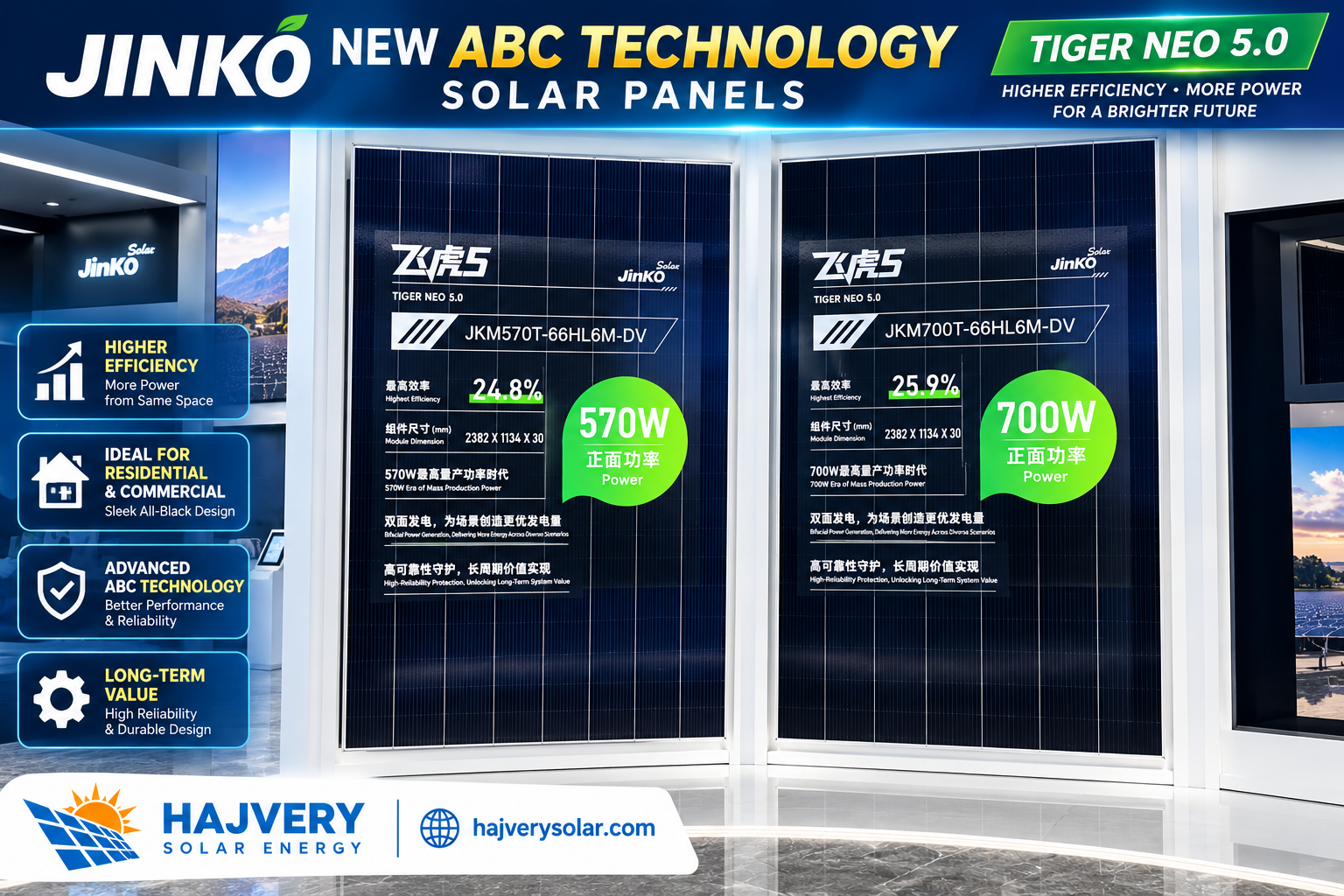
JinkoSolar has entered the high-efficiency solar market with its Tiger Neo 5.0 residential solar module. The new panel combines a premium all-black appearance with a reported 510-watt power output and 25.52% module efficiency.
This development poses an important question: Is JinkoSolar catching up in the race to advanced back-contact solar technology?
The company has introduced a new cell architecture called TAC, which combines elements of TOPCon and heterojunction technology with a back-contact electrode design. As a result, the new module represents another step in the competition to deliver more power from limited rooftop space.
For solar buyers in Pakistan, this announcement is particularly interesting. Homeowners increasingly want high-efficiency solar panels that deliver strong output without requiring a large roof area.
JinkoSolar Enters the Race for Next-Gen ABC Solar Panels
Back-contact solar technology has attracted considerable attention because it allows manufacturers to reduce visible electrical contacts on the front of solar cells. This approach can improve the usable light-receiving area and create a cleaner panel appearance.
Several manufacturers have developed advanced back-contact products. Meanwhile, JinkoSolar has continued to develop its TOPCon technology and now appears to be combining different approaches to improve performance.
The new Tiger Neo 5.0 module uses TAC (TOPCon-based amorphous-Si passivating cell) technology. It combines TOPCon-based electron conduction, amorphous-silicon passivation and a back-contact electrode architecture.
However, TAC and conventional ABC technology are not identical. Therefore, buyers should compare actual specifications rather than assume every back-contact panel uses the same cell technology.
For a detailed introduction to the product, read the official JinkoSolar Tiger Neo 5.0 announcement.
Jinko Tiger Neo 5.0 Offers 510W Output and 25.52% Efficiency.
The first announced residential version features a 48-cell configuration and an all-black design. JinkoSolar says the module is intended for premium homes and rooftops where design and power density are important.
Here are the key specifications announced by the manufacturer:
| Specification | Jinko Tiger Neo 5.0 |
| Maximum power output | 510W |
| Module efficiency | 25.52% |
| Cell technology | TAC |
| Panel design | All-black, dual-glass |
| Cell configuration | 48 cells |
| Dimensions | 1,762 × 1,134 × 30 mm |
| Weight | Approximately 22 kg |
| Temperature coefficient | -0.24%/°C |
| Product warranty | 40 years |
| Linear power-output warranty | 40 years |
These figures are based on the manufacturer’s announcement and technical information. Actual performance depends on installation conditions, temperature, shading and other site-specific factors.
Why 25.52% Solar Panel Efficiency Matters
Solar panel efficiency indicates how effectively a module converts the sunlight reaching its surface into electricity.
For example, a higher-efficiency panel can produce more power from a similar surface area than a less efficient panel under comparable conditions.
This matters when installing solar panels on homes with limited roof space. A higher-efficiency module may help homeowners increase system capacity without expanding the installation area.
However, efficiency alone does not determine the best purchase. Buyers should also consider the panel’s price, degradation rate, warranty conditions, installation costs and compatibility with their solar inverter.
How Jinko’s New TAC Technology Works
JinkoSolar has introduced several design features intended to improve energy conversion, electrical performance and the appearance of its new residential module.
1. A Gapless Cell Layout
The manufacturer uses Gapless Cell Array technology to reduce the spaces between cells. It also employs concealed electrical interconnections to limit inactive areas on the panel surface.
According to JinkoSolar, this approach increases the effective light-receiving area by about 2% and adds around 10W of module output.
2. Improved Electrical Interconnections
The panel incorporates Uniform Matrix Interconnection technology. This design distributes electrical connections rather than relying on conventional printed main busbars.
As a result, the company says it can shorten current paths and reduce resistance losses. The interconnection process also reduces mechanical stress on the cells.
These changes are intended to improve how electricity moves through the module while supporting longer reliability.
3. A More Uniform Black Appearance
The Tiger Neo 5.0 features All Consistent Colour technology, which aims to reduce visible differences between individual cells and other panel materials.
This gives the module a more consistent black appearance. As a result, it may appeal to homeowners who prefer solar panels which merge into dark roofs and modern architectural designs.
4. Better Utilisation of Available Light
JinkoSolar also uses Full-Spectrum Light Trapping technology. It combines surface texturing, anti-reflective coatings and rear-side reflection to improve light utilisation.
The company intends these features to support energy collection under diverse lighting conditions, including oblique sunlight and lower irradiance.
Actual energy generation will still depend on the installation’s orientation, weather, shading and operating conditions.
A 40-Year Warranty Could Be a Major Selling Point.
Solar panels are a long-term investment. Therefore, warranty coverage is an important consideration when comparing premium solar modules.
JinkoSolar states that the new module comes with a 40-year product warranty and a 40-year linear power-output warranty.
A longer warranty may provide additional reassurance. Nevertheless, buyers should check the official warranty document for exclusions, claim procedures, degradation guarantees and the conditions required to make a claim.
The panel also features a perimeter moisture barrier designed to reduce moisture ingress and the associated risk of corrosion. In addition, its electrical design intends to reduce power losses and hot-spot risks under partial shading.
These features are intended to support reliability over the module’s service life. However, operating experience and independent testing must assess actual durability.
Can Jinko Compete With Established ABC Solar Panel Technology?
The launch adds another option to the competition between TOPCon, heterojunction and back-contact solar technologies.
ABC solar panels are known for their back-contact architecture, which places electrical contacts on the rear of the cells. This can improve the front surface’s appearance and reduce shading from front-side contacts.
JinkoSolar’s TAC design takes a different approach, combining multiple cell technologies in a new architecture.
The announced 25.52% efficiency puts the module in the high-efficiency residential category. However, determining whether it outperforms competing ABC panels requires a model-by-model comparison using verified specifications and independent performance data.
Buyers should examine:
- Module efficiency: How much power the panel can produce per unit of surface area.
- Temperature coefficient: How output changes as the panel heats up.
- Degradation rate: How much performance the panel is expected to lose over time.
- Warranty coverage: What protection applies to the product and its power output.
- Price per watt: Whether the performance advantage justifies the additional cost.
Ultimately, the best technology depends on the buyer’s budget, roof space, and expected energy needs.
What Does This Development Mean for Solar Buyers in Pakistan?
Pakistan’s solar market includes homeowners, commercial users, and businesses wanting to reduce electricity costs. As a result, developments in high-efficiency solar technology are worth watching.
The new Jinko module could interest premium residential customers who want a sleek black finish and high power output from a relatively compact panel.
However, the announced specifications do not mean the module is already available in Pakistan. JinkoSolar did not disclose commercial availability, pricing, or production volumes for this TAC-based residential model in the announcement.
Therefore, buyers should avoid assuming that its future price will match existing Jinko solar panels available in local markets.
If you are researching solar panel prices in Pakistan, compare currently available models by wattage, efficiency, technology, and warranty. Also consider whether a higher-priced panel provides enough extra energy to justify the greater upfront cost.
For other solar products, including panels, inverters and lithium batteries, visit Hajvery Solar Energy to view available products and relevant market information.
Is It Worth Waiting for Jinko’s New Solar Panel?
The Tiger Neo 5.0 is an interesting development because it combines high reported efficiency, an all-black design and a long stated warranty.
Nevertheless, the right buying decision depends on realistic factors, not headline specifications alone.
Homeowners with limited roof space may benefit from comparing high-efficiency modules. On the other hand, buyers with larger roofs may find that a more affordable panel offers better overall value.
Remember that the panel’s real-world performance depends on installation quality, weather conditions, inverter compatibility, and maintenance.
Before choosing a premium module, request its official datasheet, warranty documentation and a quotation from a reliable supplier.
Frequently Asked Questions
What are Jinko ABC solar panels?
The term Jinko ABC solar panels may be used when discussing Jinko’s position in the back-contact technology market. However, the newly announced Tiger Neo 5.0 uses TAC technology, which combines TOPCon, amorphous-silicon passivation and a back-contact electrode architecture. It should not automatically be classified as a conventional ABC product.
What is the efficiency of the Jinko Tiger Neo 5.0?
JinkoSolar reports a maximum module efficiency of 25.52% for its new 510W, 48-cell residential panel.
Does the new Jinko panel have a 40-year warranty?
Yes. JinkoSolar states that the module has a 40-year product warranty and a 40-year linear power-output warranty. Buyers should review the official terms before purchasing.
Is the new Jinko TAC panel available in Pakistan?
The cited announcement does not confirm its availability and pricing in Pakistan. Contact an authorised supplier for current stock information and official product documentation.
Are ABC solar panels better than TOPCon panels?
Not in every situation. Performance depends on the specific module, its efficiency, temperature coefficient, degradation characteristics, warranty and price. Buyers should compare verified datasheets instead of choosing solely by technology name.
Final Verdict
JinkoSolar’s Tiger Neo 5.0 launch highlights how manufacturers are combining different solar cell technologies to improve rooftop power output and appearance.
Its reported 510W output, 25.52% efficiency and 40-year warranty make it a remarkable product announcement. Still, its commercial availability, pricing and long-term field performance remain important questions.
For Pakistan’s solar buyers, the best method is to compare currently available Jinko solar panels, ABC solar panels and other high-efficiency solar panels based on verified specifications, warranty support and total installation cost. This will help ensure the selected system delivers value and performance.
External reference: JinkoSolar’s official announcement of the Tiger Neo 5.0.
 Crown
 FUJI
 INVENT
 INVT (CHF)
 VEICHI
 EVE
 INVEREX