
Blog
How to Verify Original Solar Panels in Pakistan Before Buying
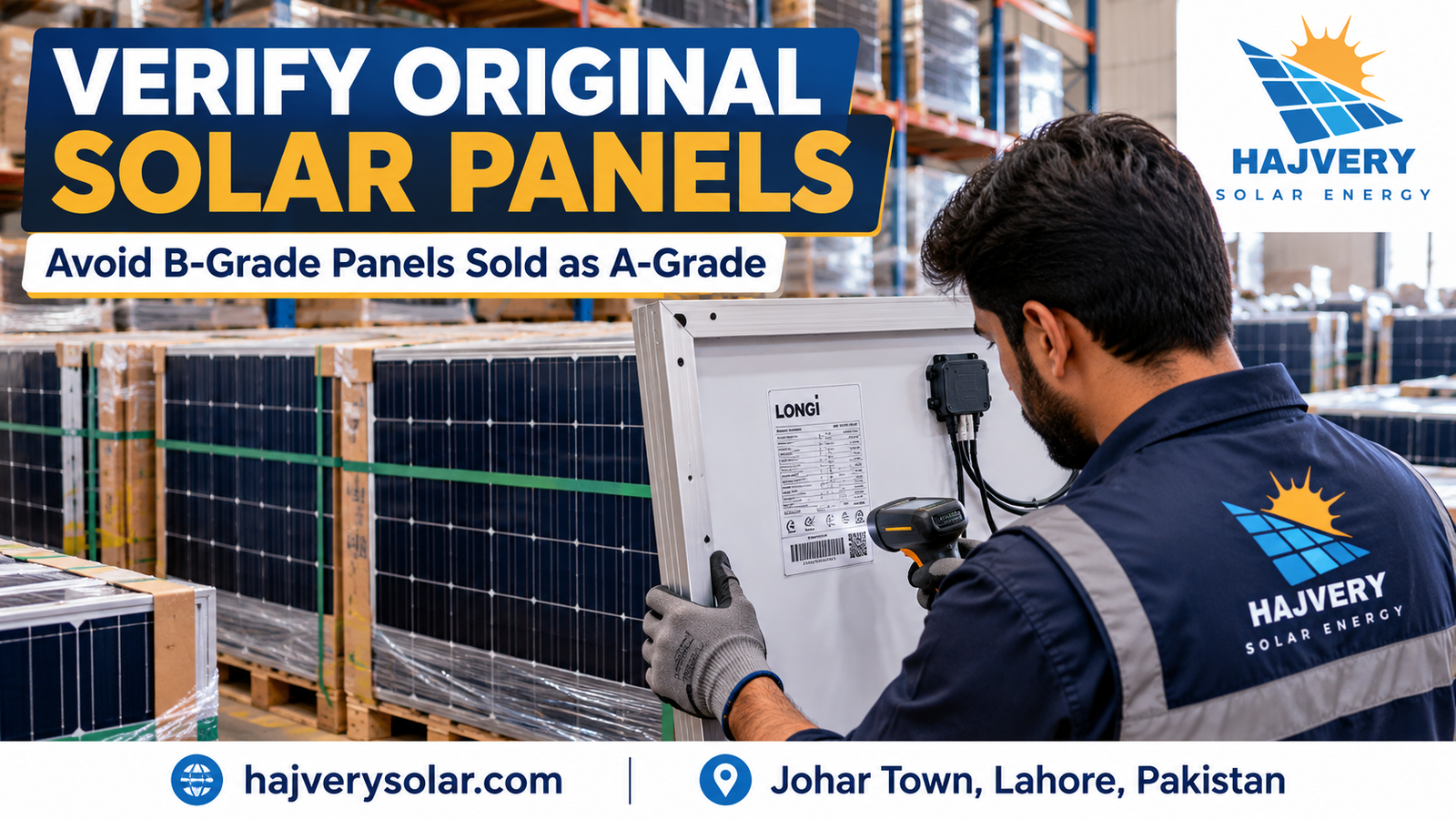
Buying solar panels is a major investment for homes, businesses, and industries. However, choosing the right solar panel involves more than comparing wattage and price. Buyers must also check authenticity, product condition, manufacturer warranty, and actual specifications.
In Pakistan, customers often compare LONGi, Jinko, Canadian Solar, JA Solar, AIKO and other popular solar panel brands. However, even a genuine brand name doesn’t guarantee every panel is new, defect-free, or sold with the warranty you expect.
Some sellers may offer B-grade, damaged, refurbished or older-stock solar panels as new A-grade products. As a result, buyers may pay premium prices for modules that don’t fulfil their expectations.
This guide explains how to verify original solar panels in Pakistan, use manufacturer verification resources, spot potential B-grade panels, and protect yourself before you buy.
Why Should You Verify Solar Panels Before Buying?
A solar panel can look genuine but still have issues with its condition, rated power, or warranty eligibility. Therefore, buyers should check the actual product rather than relying only on the brand name or seller’s claims.
Accurate verification can help you:
- Confirm the manufacturer and exact model.
- Check whether the panel’s serial number can be verified.
- Identify possible label changes or mismatched specifications.
- Detect visible damage before installation.
- Confirm the applicable product and performance warranties.
- Reduce the risk of buying B-grade panels at A-grade prices.
- Compare the solar panel price in Pakistan with greater confidence.
Most importantly, remember that authenticity, quality grade and warranty eligibility are three different things. A genuine panel may still have defects or limited warranty coverage.
How to Verify Original Solar Panels in Pakistan
Follow these steps before paying for your solar panels. For larger orders, complete the checks while the panels are still accessible on their pallets.
1. Check the Solar Panel Label and Model Number
First, inspect the manufacturer’s label on the back of the solar panel. It typically includes key electrical and identification details.
Check the following information:
- Manufacturer and brand name.
- Exact model number.
- Rated power in watts.
- Serial number or barcode.
- Maximum power voltage and current.
- Open-circuit voltage and short-circuit current.
- Maximum system voltage and other applicable ratings.
Next, compare the label with the official datasheet for the exact model.
For example, if you purchase a 650W N-type bifacial solar panel, confirm that its model number, wattage and technology match the manufacturer’s documentation. Do not rely solely on the wattage printed on a seller’s quotation.
Look for misspellings, inconsistent fonts, damaged labels, or signs that another sticker covers the original version information. These signs warrant further investigation, though a suspicious label alone does not prove fraud.
2. Verify the Solar Panel Serial Number
A serial number is one of the most useful pieces of information when checking a solar panel.
Visit the manufacturer’s official website and look for its product authentication, serial-number verification or customer-support service. Enter the serial number exactly as printed, or scan the QR code if the manufacturer provides an official scanning process.
Check whether the returned information matches:
- The manufacturer and product model.
- The rated wattage and relevant product series.
- The available production or batch information.
- Any other details provided by the manufacturer’s verification system.
If the system reports no record, an error or conflicting information, contact the manufacturer or its authorised support channel before accepting the panels.
Important: A successful serial-number check does not automatically prove that a panel is A-grade or unused. A genuine B-grade or previously used panel may also have a valid serial number.
3. Use the Hajvery Solar Energy Verification Portal
Hajvery Solar Energy provides online solar product information and verification resources to help buyers check panel details before purchase.
Visit the Hajvery Solar Energy solar panel page and locate the solar panel verification option. Select the relevant brand-specific verification resource where available, and follow the instructions shown on that page.
Before relying on a verification result, check that the details match the exact panel model and that the verification method is appropriate for that manufacturer.
If the available page provides product identification guidance instead of a direct manufacturer database lookup, use it as a starting point and confirm authenticity with the manufacturer’s official channel.
If you buy a panel from another seller, keep the invoice and ask the manufacturer or its authorised representative to confirm the applicable verification and warranty process.
4. Compare the Panel With the Official Datasheet
The manufacturer’s datasheet helps you check whether the supplied module meets its advertised specifications.
Compare the following details:
- Rated power and power tolerance.
- Cell technology and module construction.
- Panel dimensions and weight.
- Voltage and current ratings.
- Temperature coefficient.
- Product warranty and performance warranty.
For instance, two 620W solar panels may have different efficiencies, dimensions and electrical characteristics. Therefore, don’t assume every panel with the same wattage is interchangeable.
The datasheet must match the exact model code printed on the module, not just the brand or product family.
5. Inspect the Solar Panel’s Physical Condition
Inspect the panels before installation and, if possible, before the delivery vehicle leaves.
Look for the following warning signs:
- Cracked or chipped glass.
- Bent frames or damaged corners.
- Visible cracks in cells or unusual discolouration.
- Bubbles or separation in the laminate.
- Yellowing or damage to the backsheet.
- Loose junction boxes or damaged cables.
- Signs of repairs, resealing or previous mounting.
Also check the packaging and pallet labels. The brand, model and quantity must match your purchase documents.
Some cosmetic differences can occur between legitimate production batches. However, always investigate apparent damage or signs of repair before accepting the product as new A-grade stock.
6. Ask for Flash-Test Reports and Electroluminescence Testing
For bulk purchases, ask whether serial-number-linked factory flash-test reports are available.
A flash test measures a module’s electrical performance under regulated conditions. Its report may include power output, voltage, current and other electrical parameters.
Electroluminescence (EL) testing uses specialised equipment to reveal cell cracks and defects that a standard visual inspection may miss.
These tests can provide additional evidence about panel condition, especially when purchasing a full pallet or container.
However, the availability and format of factory reports vary. A missing report is not automatic proof of fraud, and you should check any report against the actual serial numbers supplied.
Do not attempt electrical testing yourself unless you are trained to handle solar DC equipment safely.
What Are A-Grade and B-Grade Solar Panels?
Buyers searching for the best solar panels in Pakistan often encounter terms such as A-grade, B-grade, C-grade and Tier 1. These terms do not all describe the same thing.
A-Grade Solar Panels
A-grade generally refers to modules that meet the manufacturer’s applicable quality requirements for normal sale. Buyers should still confirm the product’s physical condition, rated power, documentation and warranty.
A reputable seller should clearly state the grade being supplied and provide the supporting purchase documentation.
B-Grade Solar Panels
B-grade usually refers to modules that do not meet one or more of the manufacturer’s normal quality or sorting criteria. Depending on the manufacturer and product, issues may include cosmetic defects, cell irregularities or electrical performance outside the preferred quality range.
Not every B-grade panel has the same defect. Therefore, buyers should ask why the module was classified as B-grade, what its measured output is, and whether any warranty applies.
B-grade panels are not automatically counterfeit. The problem occurs when a lower-grade product is sold as a new A-grade module without proper disclosure.
Refurbished or Used Solar Panels
Refurbished panels may have been repaired, reconditioned or recovered from an earlier installation. Used panels have already been in service.
These panels may still produce electricity, but their history, condition, remaining useful life, and warranty coverage may differ from those of new modules.
Always ask the seller to disclose whether the panels are new, used, refurbished or clearance stock.
Does Tier 1 Mean a Panel Is A-Grade?
No. Tier 1 generally refers to manufacturer bankability and financial criteria, not the quality grade of an individual module.
A recognised manufacturer’s name or Tier 1 status does not prove that a specific panel is genuine, undamaged, unused or eligible for a particular warranty.
Check the individual product and its documentation before purchasing.
How Are B-Grade Solar Panels Sometimes Sold as A-Grade in Pakistan?
Several ways can mislead buyers about a panel’s grade or condition. These are potential warning signs, not proof that every low-priced seller uses these practices.
1. Selling Genuine B-Grade Panels as A-Grade
A seller may offer genuine modules that have cosmetic or electrical defects but describe them as first-quality stock.
The brand may be authentic, and the serial number may even verify successfully. However, the product condition may not match what the customer paid for.
How to avoid it: Ask for the grade to be stated in writing on the quotation or invoice. For larger orders, request supporting quality documentation and inspect the supplied batch.
2. Replacing or Altering Product Labels
A panel may have a damaged, replaced or inconsistent label. In more serious cases, the displayed wattage or model may not match the actual module.
How to avoid it: Compare the label with the official datasheet, inspect for signs of alteration and verify the serial number through the appropriate manufacturer channel.
Do not assume that a new-looking sticker proves that a module is new.
3. Mixing Different Grades in One Pallet
A pallet may contain panels with different conditions, production batches or specifications, even when the outer packaging looks consistent.
How to avoid it: Check the model and serial information across the shipment. For large orders, record the supplied serial numbers and inspect a reasonable sample before accepting delivery.
If any panels differ from the agreed specification, document the discrepancy immediately.
4. Selling Old or Used Panels as New Stock
Older inventory is not necessarily defective. However, do not represent used panels or repaired modules as new products without disclosure.
How to avoid it: When available, ask for production information, inspect the panels for mounting or repair marks, and obtain written confirmation of their condition.
Also confirm whether the manufacturer’s warranty remains valid for the particular stock.
5. Offering an Unusually Low Price Without Obvious Documentation
A low solar panel price in Pakistan can be legitimate when market conditions, stock clearance or order quantities differ. Nevertheless, a large, unexplained discount should prompt additional checks.
How to avoid it: Compare the exact model and wattage, not just the brand. Ask why the price differs and confirm the grade, warranty, condition and invoice details before paying.
The cheapest solar panel isn’t necessarily the best value if it has undisclosed defects or limited warranty protection.
How to Avoid Buying B-Grade Panels at A-Grade Prices
Use this checklist before completing your purchase.
- Choose the exact brand, model and wattage you need.
- Check the manufacturer’s datasheet and product specifications.
- Verify serial numbers through an official channel, if applicable.
- Inspect the physical condition of the actual panels.
- Ask whether the panels are A-grade, B-grade, used or refurbished.
- Obtain written confirmation of the grade and warranty terms.
- Request available serial-linked test reports for bulk orders.
- Record the serial numbers and take photographs at delivery.
- Obtain a proper invoice showing the model, quantity and agreed condition.
- Resolve any differences before installation.
For large solar installations or wholesale orders, consider an independent technical inspection if the seller cannot provide sufficient evidence of the batch condition.
Solar Panel Verification Links for Popular Brands
The following resources help you begin checking the products sold under popular solar panel brands. Use the manufacturer’s official website for authentication wherever a direct serial-number service is available.
- LONGi Solar: Official LONGi website
- Jinko Solar: Official Jinko Solar website
- Canadian Solar: Official Canadian Solar website
- JA Solar: Official JA Solar website
- Trina Solar: Official Trina Solar website
- AIKO Solar: Official AIKO website
- Astronergy: Official Astronergy website
- Risen Energy: Official Risen Energy website
- TW Solar: Official Tongwei website
- TCL Solar: Official TCL website
These links lead to manufacturer websites, not necessarily to direct serial-number verification forms. Look for product authentication or assistance options, or contact the manufacturer if no public verification tool is available.
You can also explore the solar panels available through Hajvery Solar Energy to compare brands, product specifications and available models. Authentication techniques may differ by manufacturer, so don’t assume one portal can independently authenticate every brand.
Where to Buy Solar Panels in Pakistan
When comparing solar panel prices in Pakistan, choose a supplier that clearly identifies the product, provides an invoice and explains the applicable warranty.
Hajvery Solar Energy supplies solar panels, solar inverters and lithium batteries from Lahore, with delivery options across Pakistan. Buyers can review available models, compare specifications and contact the company for current stock and wholesale quotations.
Before placing an order, validate the exact model, wattage, condition, warranty terms and delivery arrangements.
Explore these resources:
- Solar panel prices in Pakistan
- Tier 1 solar panel manufacturers list
- Solar panel types and technologies in Pakistan
The right solar panel is not simply the one with the highest wattage or lowest price. It is the one that meets your requirements, meets its documented specifications and comes with clearly stated product condition and warranty terms.
Frequently Asked Questions
How can I check whether a solar panel is original in Pakistan?
Check the manufacturer label, exact model and serial number. Use the manufacturer’s official verification process, compare the module with its datasheet, and inspect the product before installation.
Can a genuine solar panel be B-grade?
Yes. A genuine manufacturer can produce or classify a module as lower-grade stock. Serial-number verification establishes product identity where the system supports it, but does not necessarily establish the panel’s grade or condition.
How can I identify B-grade solar panels?
Look for physical defects, mismatched specifications, signs of repair and unclear warranty documentation. However, some cell defects require professional electrical or electroluminescence testing, so visual inspection alone cannot establish every panel’s grade.
Is a low solar panel price a sign of a fake product?
Not necessarily. Prices can vary because of stock, technology, model, order quantity and business conditions. An unusually low price should encourage you to verify the exact product, grade and warranty before paying.
Does Tier 1 mean a solar panel is original and A-grade?
No. Tier 1 refers to manufacturer bankability criteria, not an individual panel’s condition. Check authenticity, physical condition, specifications and warranty separately.
Should I check solar panels before installation?
Yes. Inspect the panels and record their serial numbers before installation. It is easier to resolve missing items, apparent damage or product mismatches while the panels are still accessible.
What should I do if I can’t verify the serial number?
Do not assume the panel is fake immediately. Check for typos, confirm you’re on the correct manufacturer’s website, and contact the manufacturer’s support team. If the discrepancy remains unresolved, ask the seller to provide evidence before accepting or installing the panel.
What documents should I get when buying solar panels?
Request an itemised invoice, the exact model and quantity, written confirmation of the supplied condition, applicable warranty details and available serial-number or test documentation.
Final Thoughts
Verifying solar panels before buying can help protect your investment and reduce the risk of paying A-grade prices for lower-grade or previously used products.
Always check the serial number, model specifications, physical condition and warranty. For bulk purchases, also inspect the shipment and request supporting quality documents.
Most importantly, remember that a genuine brand name does not guarantee A-grade condition. Verify the actual panels, document the agreed terms, and buy from a supplier that is transparent about what they’re selling.
 Crown
 FUJI
 INVENT
 INVT (CHF)
 VEICHI
 EVE
 INVEREX