
Blog
Solar Atta Chakki Price In Pakistan and India.
The demand for solar-powered agricultural machinery is increasing in Pakistan and India. Rising electricity costs, expensive diesel and frequent power interruptions encourage farmers and small business owners to explore solar energy. A solar-powered flour mill offers an opportunity to grind wheat while reducing dependence on grid electricity.
However, choosing the right machine requires more than checking its purchase price. Buyers must consider motor capacity, solar panel wattage, inverter technology, grinding output and installation costs.
In this guide, we explain the solar atta chakki price in Pakistan and India, compare different motor capacities, discuss solar panel requirements and explain how to select a suitable flour mill for home or commercial use.
What Is a Solar Atta Chakki?
A solar atta chakki is a wheat-grinding machine that uses electricity generated by solar panels to operate its motor. It converts whole wheat grains into fresh flour without depending entirely on conventional electricity or diesel generators.
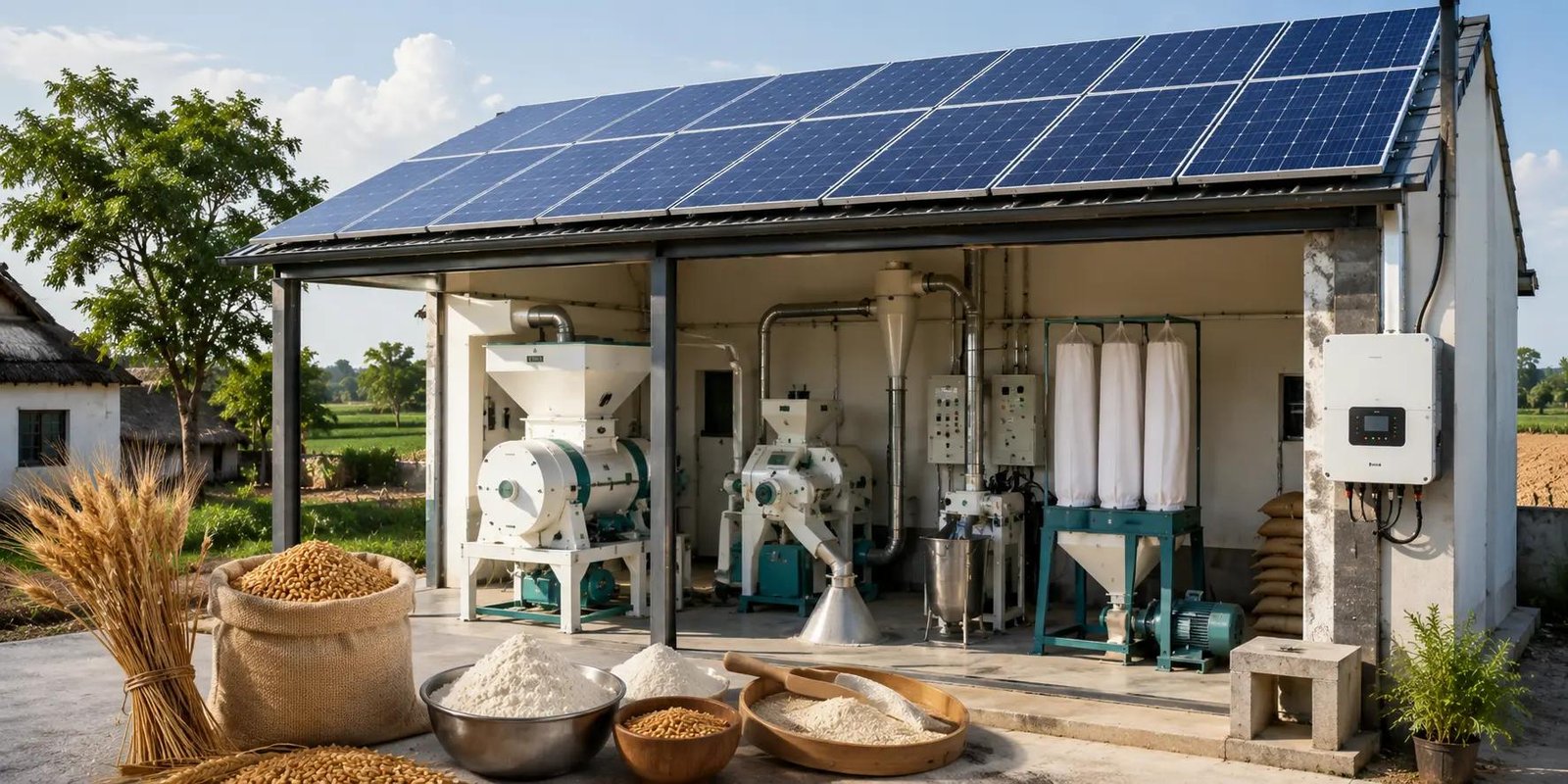
The system generally consists of four main components:
- Solar panels: Generate electricity from sunlight.
- Solar inverter or VFD: Converts and controls electrical power supplied to the motor.
- Electric motor: Drives the grinding stones or milling mechanism.
- Flour mill machine: Processes wheat into flour.
Some systems also include batteries. However, batteries are not always necessary because a properly designed solar-powered mill can operate directly during daylight hours.
The solar photovoltaic technology guide from the US Department of Energy explains how solar panels convert sunlight into electricity.
For buyers in Pakistan, comparing solar panels and their prices at Hajvery Solar Energy can help when planning the solar component of a flour-milling system.
Solar Atta Chakki Price in Pakistan 2026
In Pakistan, the overall investment depends on motor capacity, solar panel quality, inverter specifications and installation requirements.
Below are indicative online market estimates for complete solar-powered systems. These are budget-planning figures, not guaranteed dealer quotations.
Estimated prices by motor capacity in Pakistan
| Machine capacity | Estimated complete system price |
|---|---|
| 5 HP | Rs. 600,000–750,000 |
| 10 HP | Rs. 1,200,000–1,400,000 |
| 15 HP | Rs. 1,600,000–1,900,000 |
| 20 HP | Rs. 2,200,000–2,600,000 |
Prices can change according to the city, machinery manufacturer, solar panel wattage, inverter brand and installation requirements.
5 HP solar flour mill in Pakistan
A 5 HP machine is suitable for households, small villages and shops with limited grinding requirements.
It requires a suitably sized solar array and a compatible motor controller. A typical preliminary design may use approximately 6–8 kW of solar panels, although the final capacity depends on motor efficiency and operating conditions.
It is a reasonable starting point for someone who wants to grind wheat for personal use or serve a small number of customers.
10 HP solar flour mill in Pakistan
A 10 HP model is suitable for small commercial flour mills and shops with regular customers.
A preliminary solar design may require around 10–12 kW of solar panels. A compatible three-phase inverter or solar VFD may also be required, depending on the motor.
This capacity offers a balance between investment and grinding output.
15 HP solar flour mill in Pakistan
A 15 HP machine is suitable for a growing flour mill business.
It can handle higher workloads than smaller machines. However, its performance depends on the grinding stone, motor speed, wheat quality and moisture content.
A preliminary solar array of approximately 15–18 kW may be considered.
20 HP commercial flour mill in Pakistan
A 20 HP machine is designed for businesses with substantial daily grinding requirements.
A system of approximately 20–25 kW of solar panels may be suitable as an initial design estimate. A heavy-duty three-phase solar VFD is particularly important for handling the motor’s starting torque.
Before purchasing, ask the supplier to calculate the complete electrical load.
Solar Atta Chakki Price in India 2026
India has a growing market for solar-powered agricultural machinery. Manufacturers and suppliers offer different configurations, including 5 HP, 7.5 HP, 10 HP, 15 HP and 20 HP flour mills.
The following indicative prices are based on published online product listings for solar flour mill packages.
Estimated prices in India
| Machine capacity | Indicative package price |
|---|---|
| 5 HP | ₹3,30,000 |
| 7.5 HP | ₹4,60,000 |
| 10 HP | ₹5,90,000 |
| 15 HP | ₹8,50,000 |
| 20 HP | ₹10,60,000 |
These figures are examples of listed package prices, not a universal Indian market rate. Package specifications, panel wattage, warranty and included equipment can differ between suppliers.
5 HP solar aata chakki in India
A 5 HP model is a suitable option for farmers and small business owners who want to reduce electricity expenses.
It can be used for household wheat grinding and small commercial operations.
10 HP solar flour mill in India
A 10 HP system offers higher processing capacity. It is suitable for village shops, small flour mills and businesses that receive regular orders.
Buyers should check the number of solar panels included in the package and confirm whether the inverter is designed for the supplied motor.
15 HP and 20 HP commercial flour mills
These machines are more suitable for commercial operations.
They require a larger solar array, suitable electrical protection and a properly rated motor controller. A supplier should also confirm the grinding output per hour before accepting an order.
Solar Panel Requirements for Different Flour Mill Capacities
The solar array must provide sufficient power to operate the motor during productive sunlight hours.
The following table provides preliminary sizing guidance.
| Motor capacity | Suggested solar array |
|---|---|
| 5 HP | 6–8 kW |
| 7.5 HP | 8–10 kW |
| 10 HP | 10–12 kW |
| 15 HP | 15–18 kW |
| 20 HP | 20–25 kW |
These figures are starting estimates, not fixed engineering specifications. Actual requirements depend on motor efficiency, power factor, inverter losses, solar irradiance and the desired operating speed.
For a more accurate design, consult the US Department of Energy’s solar photovoltaic system design guide.
How many solar panels are required?
The number of panels depends on their individual wattage.
For example, consider a 10 kW solar array using 585W solar panels:
10,000 ÷ 585 = approximately 17.1 panels.
Therefore, around 18 panels would provide approximately 10.53 kW of installed DC capacity.
Likewise, higher-wattage panels can reduce the number of modules required for the same total capacity.
Buyers in Pakistan can compare different solar panel brands and current prices at Hajvery Solar Energy before selecting their required capacity.
Which Inverter Is Best for a Solar Flour Mill?
The inverter is one of the most important components of the complete system.
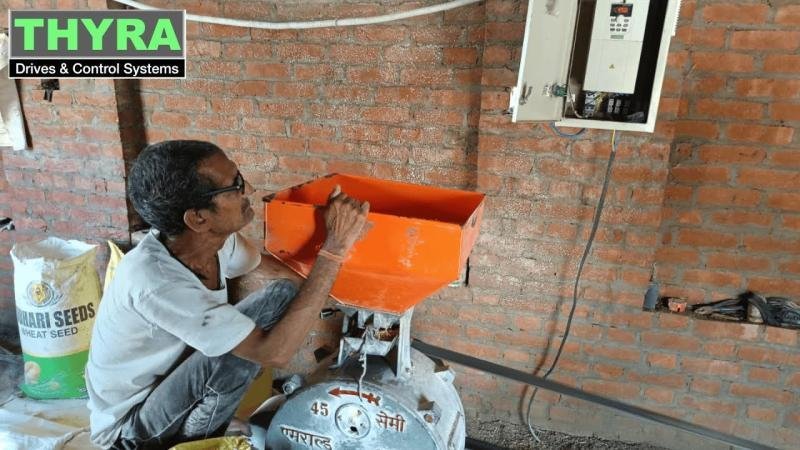
A standard residential hybrid inverter is not automatically suitable for operating heavy grinding machinery. The motor’s starting torque and electrical characteristics must match the inverter’s capabilities.
Solar VFD (Variable Frequency Drive)
A solar VFD is often a suitable choice for commercial flour mills.
Its main advantages include:
- Controls motor speed.
- Provides controlled acceleration and deceleration.
- Helps manage motor starting current.
- Can use solar DC input in compatible models.
- Offers motor protection and operating controls.
For commercial applications, buyers can explore solar VFD inverters available at Hajvery Solar Energy and compare suitable models.
Three-phase solar inverter
Larger commercial machines commonly use three-phase motors. Therefore, the selected inverter or VFD must support the correct three-phase output and motor specifications.
Before purchasing, confirm:
- Motor voltage and current.
- Rated motor power in HP or kW.
- Starting torque requirements.
- VFD output voltage and phase configuration.
- Solar input voltage and MPPT operating range.
- Manufacturer’s overload rating.
Never select an inverter based only on its advertised kW rating.
You can also compare solar inverter models and prices at Hajvery Solar Energy when planning the electrical system.
Can a Solar Flour Mill Run Without Batteries?
Yes. A properly designed solar flour mill can operate without batteries during daylight hours.
This configuration is often called a direct solar or battery-free system.
Solar panels supply power to a compatible solar VFD, which controls the motor. The machine can then grind wheat while sufficient sunlight is available.
Advantages of a battery-free system
- Lower initial investment.
- No battery replacement expenses.
- Less maintenance.
- More direct use of solar electricity.
- Suitable for daytime commercial operations.
However, power output can fall during cloudy weather. As a result, the motor may need to slow down or stop if available solar power becomes insufficient.
When should you install batteries?
Battery storage is useful if you need to operate the machine after sunset or during periods of insufficient sunlight.
However, heavy-duty flour mills can consume substantial electricity. Therefore, the battery bank must be carefully sized according to motor load and operating hours.
For businesses considering battery storage, Hajvery Solar Energy’s lithium battery range provides an opportunity to compare available energy-storage products.
The US Department of Energy’s solar and resilience guide also explains how solar energy and storage can support electricity availability.
For most businesses that can operate during peak sunlight, a battery-free configuration deserves consideration.
Benefits of Using Solar Energy for Wheat Grinding
Solar-powered milling offers several benefits for farmers, shopkeepers and commercial flour mill owners.
1. Lower electricity expenses
The system generates electricity from sunlight. Therefore, it can reduce the amount of electricity purchased from the grid.
2. Reduced diesel consumption
Businesses that previously used diesel generators can reduce their fuel consumption by shifting suitable daytime operations to solar power.
3. Better energy independence
A properly designed system can continue working during daylight hours without depending entirely on the electricity supply.
4. Suitable for rural areas
Many rural locations have agricultural businesses and available rooftop or open land for solar panels.
Solar energy can help these businesses operate more efficiently.
5. Long-term operating benefits
Solar panels can produce electricity for many years. However, the motor, VFD, bearings and grinding stones still require regular maintenance.
Is a Solar Flour Mill Profitable?
A solar-powered flour mill can be a profitable business. However, actual returns depend on local demand, grinding charges, daily working hours and the total investment.
Consider this simple example:
Suppose a small commercial flour mill processes 500 kg of wheat per day and charges Rs. 8 per kg for grinding.
Daily revenue:
500 × Rs. 8 = Rs. 4,000.
Monthly revenue for 26 working days:
Rs. 4,000 × 26 = Rs. 104,000.
This is gross grinding revenue, not net profit.
You must deduct employee salaries, rent, maintenance, transportation, machine depreciation and other operating expenses.
In India, use the same calculation with local grinding charges in rupees. In both countries, check demand in your area before investing.
Important Factors to Check Before Buying
Before selecting a machine, compare more than its purchase price.
Motor quality
Ask about the motor manufacturer, efficiency rating, rated current and warranty.
Grinding capacity
Ask the manufacturer how many kilograms of wheat the machine can process per hour.
Do not rely only on HP ratings. Two machines with similar motors may have different grinding outputs.
Grinding stone quality
The quality and diameter of the grinding stones can affect flour texture, output and maintenance requirements.
Solar panel quality
Choose genuine solar panels with proper product warranties and manufacturer documentation.
Inverter compatibility
Confirm that the solar VFD or inverter is compatible with the motor.
After-sales service
Choose a supplier who can provide spare parts, technical support and warranty services.
For buyers in Pakistan, Hajvery Solar Energy’s online solar products shop provides access to solar panels, inverters, lithium batteries and VFD equipment.
Solar Flour Mill vs Traditional Electric Flour Mill
| Feature | Solar-powered mill | Traditional electric mill |
|---|---|---|
| Main energy source | Solar panels | Grid electricity |
| Daytime operating cost | Lower after investment | Depends on electricity tariff |
| Initial investment | Generally higher | Generally lower |
| Battery requirement | Optional | Not applicable |
| Grid dependence | Can be reduced | Usually required |
| Maintenance | Solar and machine components | Mainly machine and electrical components |
A solar-powered system may be more economical over time, especially in areas with high electricity costs and good sunlight.
Frequently Asked Questions (FAQs)
1. What is the cost of a solar atta chakki in Pakistan?
A complete system can cost approximately Rs. 600,000 to Rs. 2,600,000 in the indicative 5 HP to 20 HP categories. The final quotation depends on the motor, panels, inverter and installation.
2. What is the cost of a solar flour mill in India?
Published package examples range from approximately ₹3,30,000 for a 5 HP model to ₹10,60,000 for a 20 HP model. Prices vary by supplier and package specifications.
3. Can a 5 HP flour mill run on solar panels?
Yes. A properly designed solar system can operate a 5 HP motor. The panel array, VFD and electrical configuration must match the motor requirements.
4. Does a solar-powered chakki require batteries?
No. Batteries are optional if you operate the machine during sufficient daylight. They are useful when you need additional operating hours.
5. How many solar panels are required for a 10 HP flour mill?
A preliminary 10–12 kW solar array may be considered. The exact number depends on panel wattage and system design.
6. Can a flour mill operate during cloudy weather?
It may continue operating at reduced output if the VFD can adjust motor speed and sufficient solar power remains available. However, heavy cloud cover can interrupt operation.
7. Is a solar flour mill suitable for a village business?
Yes. It can be suitable for village shops and rural businesses where there is sufficient demand for wheat grinding and adequate space for solar panels.
8. Which is better: a 5 HP or 10 HP flour mill?
A 5 HP machine is more suitable for smaller requirements. A 10 HP model is better for businesses with more customers and higher daily grinding demand.
Conclusion
A solar-powered flour mill can be a useful investment for farmers, rural entrepreneurs and commercial grinding businesses in Pakistan and India.
The right choice depends on your daily wheat-grinding requirements, available space, motor capacity and budget.
A smaller 5 HP machine may suit household or small-shop requirements. Meanwhile, 10 HP, 15 HP and 20 HP models can serve businesses with higher processing needs.
Before purchasing, compare machinery quality, solar panel capacity, inverter specifications and after-sales support. A properly designed system can help reduce electricity expenses and improve the long-term economics of flour milling.
For buyers in Pakistan looking for solar panels, inverters, lithium batteries and VFD equipment, visit Hajvery Solar Energy – Official Website to explore available products and wholesale prices.
 Crown
 FUJI
 INVENT
 INVT (CHF)
 VEICHI
 EVE
 INVEREX