
Blog
Types of Solar Panels in Pakistan: Prices, Efficiency and Latest Technologies (2026)
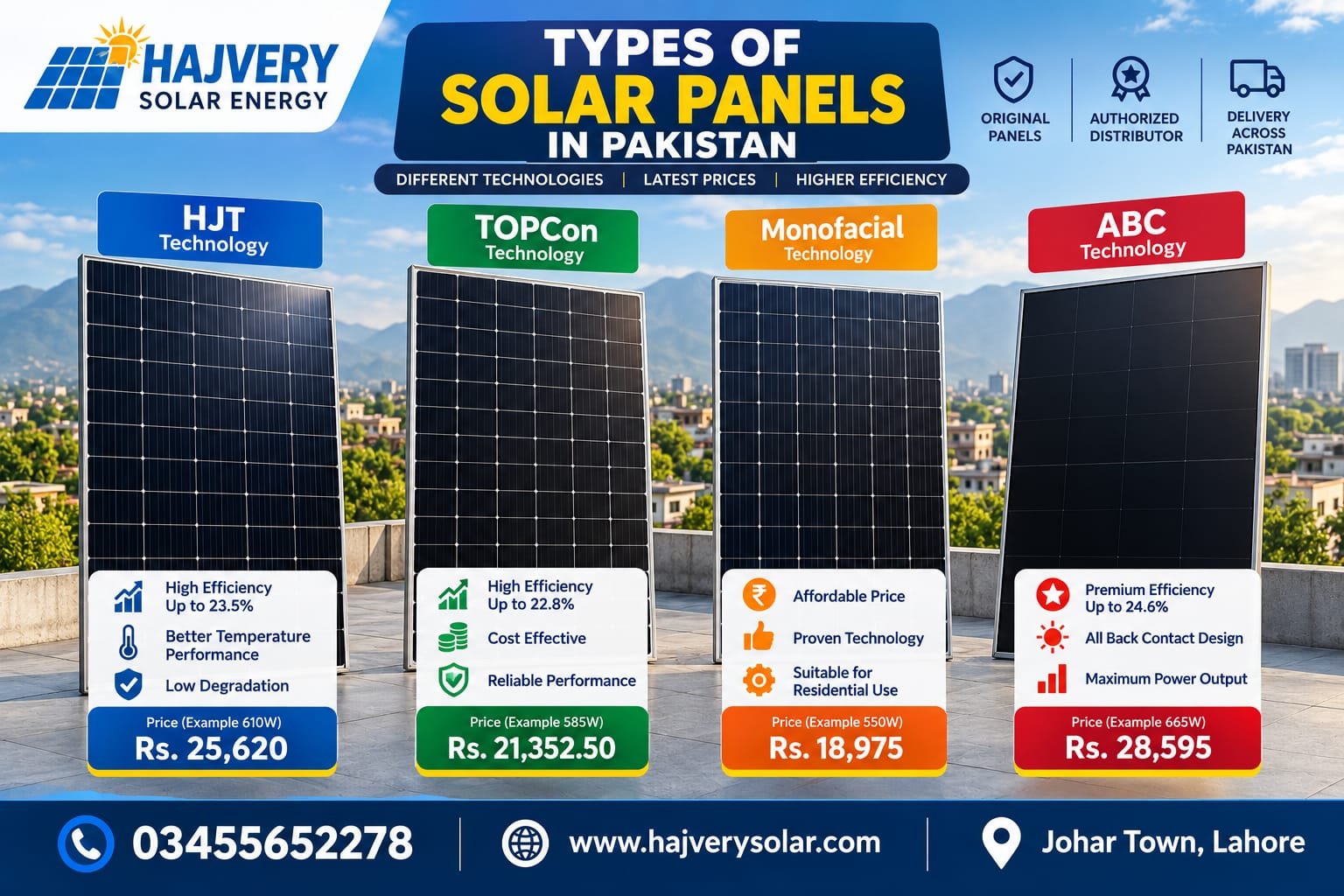
Choosing the right solar panel is one of the most important decisions when installing a solar system in Pakistan. With rising electricity bills and increasing demand for renewable energy, homeowners and businesses are looking for panels that deliver maximum power, durable reliability, and excellent value for money. Moreover, understanding different solar panel technologies can help buyers make a more informed decision and achieve better long-term savings.
However, not all solar modules are the same. Different types of solar panels use different cell technologies, offer varying efficiency levels, and perform differently under high temperatures, dust, and changing weather conditions.
In this complete guide, we will explore the different solar panel technologies, compare their prices, explain their advantages and disadvantages, and help you select the most suitable option for Pakistan’s climate.
Whether you are planning a residential installation or a major commercial project, knowing these technologies will help you make a smarter investment.
What Are the Main Types of Solar Panels?
Solar panels convert sunlight into electrical energy via photovoltaic (PV) cells. Manufacturers use different materials, cell structures, and manufacturing techniques to improve power output.
The most common solar panel varieties available in Pakistan include:
- Monocrystalline solar panels
- Polycrystalline solar panels
- Thin-film solar panels
- P-Type PERC solar panels
- N-Type TOPCon solar panels
- Bifacial solar panels
- HJT solar panels
- Back-contact solar panels, including HPBC and ABC
Each category has its own benefits. Therefore, buyers should consider efficiency, durability, price, and environmental conditions before deciding. However, each type of solar panel offers different benefits in terms of efficiency, performance, durability, and price.
1. Monocrystalline Solar Panels
Monocrystalline panels are among the most popular solar power modules used in Pakistan. They are manufactured using high-purity silicon crystals, which allow electrons to move efficiently and generate electricity.
These panels usually feature a dark appearance and offer better efficiency than traditional polycrystalline modules. Furthermore, these panels are an excellent choice for homeowners who want maximum power generation from limited rooftop space
Advantages
- High power output per square metre.
- Excellent performance in residential installations.
- Longer functional lifespan.
- Suitable for limited rooftop space.
- Widely available from established manufacturers.
Disadvantages
- Higher initial cost than older technologies.
- Performance can decrease as temperatures rise.
- Genuine products call for careful verification.
Best for: Homes, offices, commercial buildings and installations where roof space is limited.
2. Polycrystalline Solar Panels
Polycrystalline modules were once a common choice for residential solar installations. Manufacturers produce them by melting multiple silicon fragments together, creating a distinctive blue appearance.
Although these panels are generally less efficient than modern monocrystalline alternatives, they helped make solar energy more affordable.
Advantages
- Historically lower manufacturing costs.
- Reliable electricity generation.
- Simple technology with a long operating history.
Disadvantages
- Lower efficiency than modern N-Type modules.
- Requires more installation space for the same power output.
- Less competitive in today’s market.
Best for: Older installations and projects in which initial investment is the primary concern.
Modern buyers generally prefer advanced monocrystalline technology because it provides more electricity from the same rooftop area.
3. Thin-Film Solar Panels
Thin-film modules use extremely thin photovoltaic material deposited onto a supporting surface. Manufacturers can produce them using different materials, including cadmium telluride and amorphous silicon.
Unlike conventional glass-framed modules, some thin-film products are lightweight and flexible.
Advantages
- Lightweight construction.
- Flexible design options.
- Useful for specialised applications.
- Certain models perform well in diffuse light.
Disadvantages
- Generally lower efficiency.
- Requires more space for the same power output.
- Limited availability in Pakistan.
- Not commonly selected for standard residential rooftops.
Best for: Specialised commercial projects, lightweight structures and applications needing flexible solar technology.
4. P-Type PERC Solar Panels
PERC stands for Passivated Emitter and Rear Cell. This technology improves conventional silicon cells by adding a passivation layer at the rear, helping capture more sunlight and reduce energy losses.
PERC modules became popular because they offered improved efficiency without requiring a completely new manufacturing process.
Advantages
- More affordable than many premium technologies.
- Proven performance history.
- Suitable for residential and commercial systems.
- Widely available in the Pakistani market.
Disadvantages
- Generally higher degradation than modern N-Type alternatives.
- Lower efficiency than leading premium modules.
- Gradually being replaced by newer cell architectures.
Best for: price-sensitive buyers pursuing reliable performance without paying for the latest technology.
5. N-Type TOPCon Solar Panels
N-Type TOPCon (Tunnel Oxide Passivated Contact) is one of the most important developments in modern solar manufacturing.
It uses an advanced passivated contact structure to reduce electrical losses and improve conversion efficiency.
Many leading manufacturers now offer TOPCon modules in their latest product ranges. As a result, TOPCon panels have become a popular choice for residential and commercial solar installations in Pakistan.
Advantages
- Higher efficiency than traditional P-Type PERC modules.
- Decreased long-term degradation.
- Strong performance under different environmental conditions.
- Excellent suitability for large residential and commercial systems.
- Available in monofacial and bifacial designs.
Disadvantages
- Premium models may cost more initially.
- Performance depends on the exact module design and installation quality.
Best for: Pakistani homeowners who want a balance among affordability, efficiency and long-term electricity generation.
Popular manufacturers offering this technology include Jinko, Canadian Solar, JA Solar and other established brands.
6. Bifacial Solar Panels
Bifacial modules can generate electricity from both their front and rear surfaces. Their rear side captures reflected sunlight from the ground, rooftop, or surrounding surfaces.
This design makes them especially suitable for installations where the mounting arrangement allows sufficient light to reach the back of the panel. Consequently, these panels can produce additional electricity when installed over reflective surfaces.
Advantages
- Additional electricity generation under proper conditions.
- Excellent compatibility with N-Type technologies.
- Durable dual-glass options.
- Suitable for residential, commercial and industrial projects.
- Potentially improved energy yield over the installation’s lifetime.
Disadvantages
- Higher initial cost for some models.
- Rear-side generation depends on installation conditions.
- Closely mounted panels may receive limited reflected sunlight.
Best for: Open rooftops, elevated structures, and commercial installations with suitable reflective surfaces.
Bifacial technology is especially useful in Pakistan because many installations receive strong sunlight year-round. However, actual energy gains depend on mounting height, surface reflectivity, shading, and system design.
7. HJT Solar Panels
HJT stands for Heterojunction Technology. It combines crystalline silicon with thin layers of amorphous silicon to improve charge movement and reduce energy losses.
This technology is known for its strong temperature characteristics and high efficiency. In addition, its strong performance in high temperatures makes it suitable for Pakistan’s hot climate
Advantages
- Excellent temperature performance.
- High conversion efficiency.
- Low degradation.
- Strong potential for green energy generation.
- Appropriate for demanding commercial applications.
Disadvantages
- Higher manufacturing costs.
- Limited availability compared with TOPCon.
- Premium pricing can increase initial investment.
Best for: Buyers prioritising advanced technology and long-term performance, notably in areas with high summer temperatures.
8. HPBC and ABC Back-Contact Solar Panels
Back-contact technology is another major development in the solar industry. It places electrical contacts on the rear of the cell, leaving the front surface free from conventional metal gridlines.
Two prominent examples are LONGi’s HPBC technology and AIKO’s ABC technology.
HPBC Technology
LONGi uses Hybrid Passivated Back Contact technology in its cutting-edge Hi-MO series. Its newer HPBC 2.0 modules combine back-contact architecture with improved wafer technology.
ABC Technology
AIKO’s All Back Contact technology also moves electrical contacts to the rear of the cells, allowing more sunlight to reach the active front surface. Similarly, ABC technology improves efficiency while delivering a sleek, modern panel appearance.
Advantages
- High module efficiency.
- Excellent utilisation of available rooftop space.
- Attractive appearance.
- Reduced front-side shading from conventional gridlines.
- Advanced electrical design.
Disadvantages
- Premium pricing.
- Performance varies by model.
- Buyers should compare exact specifications rather than relying on technology names alone.
Best for: Premium residential installations, commercial rooftops and buyers who want maximum power output from limited space.
Solar Panel Price in Pakistan: Latest Comparison for 2026
The solar panel price in Pakistan depends on numerous factors, including brand, wattage, cell technology, efficiency, documentation and market availability.
Hajvery Solar Energy offers different panel categories, allowing buyers to compare cost-effective options with advanced N-Type and premium bifacial modules.
The following table uses selected product listings from Hajvery Solar Energy. Prices are indicative and may change with market conditions. However, the actual price depends on the brand, wattage, technology, availability, and current market conditions.”
| Panel type and model | Price per panel | Efficiency and technology |
|---|---|---|
| OSDA 585W Bifacial | Rs. 21,264.75 | 22.39%, N-Type TOPCon, SMBB |
| ArmPower 585W Bifacial | Rs. 21,352.50 | 22.64%, N-Type TOPCon, 16BB |
| LONGi Hi-MO X10 645W Bifacial | Rs. 27,735* | 23.9%, HPBC 2.0, N-Type |
| LONGi Hi-MO X10 655W Bifacial | Rs. 28,165 | 24.25%, HPBC 2.0, TaiRay wafer |
| AIKO Stellar 665W Bifacial | Rs. 28,595 | 24.6%, N-Type ABC |
The 645W price is calculated using the published Rs. 43 per watt reference rate. Confirm the current quotation before ordering.
These figures represent panel prices only. Installation, mounting structures, inverters, wiring and other system components are separate expenses.
For the latest solar module rates, buyers should check the product listings on the Hajvery Solar Energy website.
Factors That Affect Solar Panel Prices in Pakistan
Comprehending pricing factors can help you select a product that offers better long-term value.
1. Cell Technology
Advanced TOPCon, HJT, HPBC and ABC modules may cost more than conventional PERC panels because of their manufacturing processes and performance characteristics.
2. Wattage
Higher-wattage modules generally cost more per panel. However, they may reduce the number of panels required for a particular system capacity.
3. Efficiency
High-efficiency modules produce more electricity from a given surface area. This feature is especially valuable for homes with limited rooftop space.
4. Brand and Authenticity
Established manufacturers offer documented specifications and warranty support. Buyers should verify serial numbers and product details before purchasing.
5. Exchange Rates and Market Supply
Imported equipment prices can change due to foreign exchange shifts, transportation expenses and international supply conditions.
6. Installation Requirements
The mounting structure, inverter compatibility and available rooftop area can affect the overall project cost.
Therefore, comparing only the initial purchase price may not provide a complete picture of the investment.
How to Choose the Right Solar Panel for Your Home
Selecting a suitable module requires more than checking its wattage.
Follow these practical steps before making a purchase:
- Calculate your electricity requirements. Review your monthly consumption and identify the appliances you want to operate.
- Measure available rooftop space. High-efficiency modules can help maximise generation when space is limited.
- Compare temperature coefficients. A lower absolute power temperature coefficient generally indicates better performance as cell temperatures rise.
- Check the warranty. Review both product and performance warranties.
- Verify authenticity. Confirm the manufacturer’s model number and serial information.
- Consult a qualified installer. Ensure the inverter, mounting structure, and electrical design are compatible with the selected modules.
These steps can help you avoid unnecessary expenses and improve your solar installation’s performance.
Why Buy Solar Panels from Hajvery Solar Energy?
Hajvery Solar Energy provides a wide range of solar panel technologies in Pakistan, including conventional modules, N-Type TOPCon, bifacial panels and premium back-contact products.
Customers can compare different brands, wattages, efficiencies, and technologies to meet their requirements.
One important advantage is product verification. All panels sold through Hajvery Solar Energy can be checked online through our verification portal, allowing customers to confirm product details and feel more confident in their purchase.
Our product range supports residential, commercial and wholesale requirements.
Whether you are looking for an affordable module or a premium, high-efficiency solution, Hajvery Solar Energy helps you find the right option.
Visit our website at https://hajverysolar.com/ to view available products and request the latest quotations.
Frequently Asked Questions
Which solar panel technology is best in Pakistan?
Ultimately, the best choice depends on your budget, available roof space, electricity consumption, and long-term energy requirements. N-Type TOPCon, bifacial, and advanced back-contact technologies are excellent choices for Pakistan. The best option depends on your budget, roof space, and installation conditions.
Are bifacial panels better than monofacial panels?
Bifacial modules can generate additional electricity from reflected sunlight. However, their advantage depends on mounting height, surface reflectivity, and rear-side shading.
Are N-Type solar panels worth the extra cost?
For many long-term installations, N-Type modules offer attractive value because of their efficiency and lower degradation. However, buyers should compare the exact models and prices before deciding.
How long do modern solar panels last?
Many modern modules carry performance warranties of 25 to 30 years. Actual lifespan depends on product quality, installation, maintenance and environmental conditions.
Can solar panels withstand Pakistan’s extreme heat?
Quality modules are made to function across a wide temperature range. However, their output decreases as cell temperature increases. Selecting a module with a favourable temperature coefficient can help reduce these losses.
How can I verify original solar panels?
Check the product label, serial number, model specifications and manufacturer documentation. Hajvery Solar Energy also provides an online verification portal for checking panels purchased through the company.
Final Verdict: Which Solar Panel Is Best for the Pakistani Environment?
Therefore, comparing different solar panel technologies before making a purchase is essential for achieving the best value for money. Pakistan experiences intense summer heat, dust, seasonal smog, varying humidity, and strong sunlight. Therefore, the ideal solar module should deliver uniform performance, resist environmental stress, and provide reliable electricity generation over many years.
We recommend an N-Type bifacial solar panel, particularly a quality TOPCon or advanced back-contact model, for most modern installations.
Here is why:
- N-Type cells offer strong efficiency and reduced long-term degradation.
- Bifacial designs can increase electricity generation when installed correctly.
- Advanced technologies provide excellent power output from limited rooftop space.
- Modern modules offer suitable performance characteristics for demanding climates.
For buyers looking for premium efficiency, LONGi Hi-MO X10 HPBC 2.0 and AIKO ABC panels are excellent options to compare. For buyers prioritising a balance between price and performance, N-Type TOPCon modules from established manufacturers are also worth considering.
Ultimately, the best investment is not necessarily the most expensive panel. It is the one that combines genuine quality, suitable technology, competitive pricing and dependable warranty support.
Choose wisely, verify your panels and invest in technology that will serve your home or business for decades.
 Crown
Crown FUJI
FUJI INVENT
 INVT (CHF)
 VEICHI
 EVE
EVE INVEREX