
Blog
How Many Solar Panels Are Required To Run A 1.5 Ton AC ?
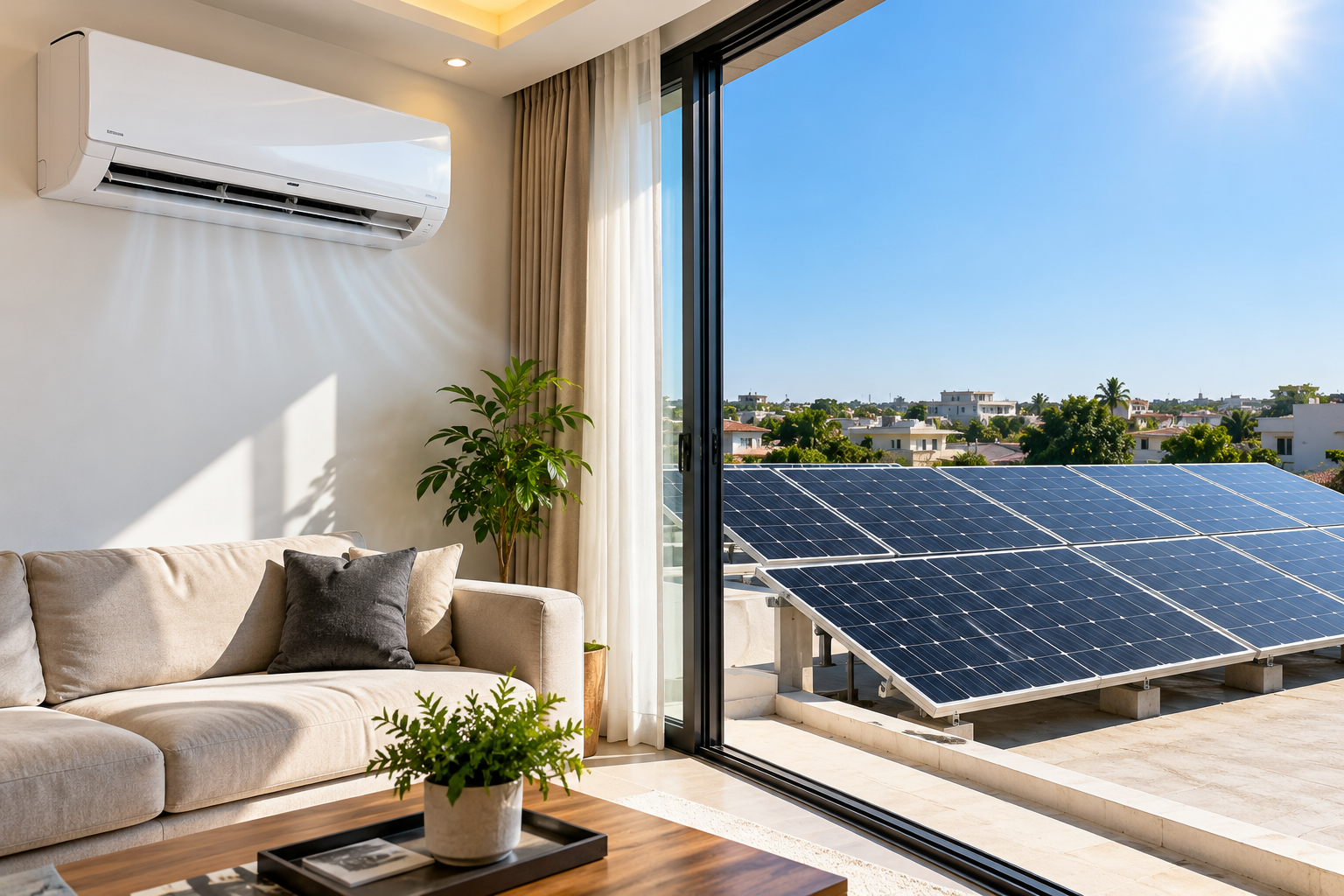
Running an air conditioner on solar energy can cut electricity bills, especially during Pakistan’s hot summer months. However, the number of panels you need depends on the AC’s power consumption, panel wattage, sunlight availability, and whether you want to run the AC only during the day or at night.
For homeowners and businesses, choosing high-efficiency solar panels can help generate more electricity from limited roof space. AIKO 665W solar panels and LONGi Hi-MO X10 645W bifacial solar panels are two options to consider for a solar system designed to run an inverter AC.
This guide explains the panel requirements for 1-ton, 1.5-ton, and 2-ton ACs, estimated system costs, daytime solar production, and factors to consider before purchasing your equipment.
Running an inverter AC with high-efficiency solar panels during sunny hours.
How Many Solar Panels Are Required to Run a 1.5 Ton AC?
For a typical 1.5-ton inverter AC, five high-wattage solar panels rated at 645W to 665W each are a practical starting point for daytime operation. These panels provide approximately 3.2–3.3 kW of installed solar capacity.
However, five panels will not guarantee continuous functioning under all conditions. Actual consumption changes with room temperature, insulation, AC efficiency, and sunlight. Older non-inverter ACs may require six or more panels, depending on their power consumption.
The following table provides an initial estimate to help you plan a solar system.
| 1 ton inverter AC | 3–4 panels | 1.94–2.66 kW |
| 1.5 ton inverter AC | 5 panels | 3.23–3.33 kW |
| 2 ton inverter AC | 7–8 panels | 4.52–5.32 kW |
These estimates use 645W and 665W panels. They are starting points for daytime operation, not guaranteed system designs. Your installer should check the AC’s rated input, starting load, and expected solar production.
How Much Electricity Does an AC Consume?
An AC’s tonnage describes its cooling capacity, not its electricity consumption. A 1.5-ton AC provides approximately 18,000 BTU of cooling per hour, but its electrical demand depends on the model and operating conditions.
An inverter AC adjusts compressor speed according to cooling demand. It may use more electricity when first cooling a hot room and less once it reaches the set temperature.
A typical 1.5-ton inverter AC might draw around 600–1,200 watts during part-load operation, although its maximum input can be considerably higher. A non-inverter model may consume roughly 1,500–1,800 watts while its compressor runs. Actual manufacturer specifications should guide your calculations. 【turn716067search0】【turn716067search4】
Why Solar Panel Wattage Matters
A 665W panel has a higher rated output than a 550W panel. So you can install fewer panels to reach a similar total capacity.
For example:
- Five 645W panels provide 3,225 watts (3.225 kW).
- Five 665W panels provide 3,325 watts (3.325 kW).
- Six 550W panels provide 3,300 watts (3.3 kW).
The five-panel option saves roof space compared with six 550W modules. However, rated wattage represents laboratory test conditions. Real-world output varies with temperature, dust, shading, panel orientation, and sunlight.
How Many Solar Panels Are Required for a 1 Ton AC?
A 1-ton inverter AC generally needs less solar capacity than a 1.5-ton unit.
For a high-efficiency 1-ton inverter AC, three to four 645W or 665W solar panels are a good starting point. Three 665W panels produce 1.995 kW of rated capacity, while four provide 2.66 kW.
If your AC uses less power once the room cools, three panels may be enough in favourable daylight conditions. Four panels provide more capacity for hot afternoons and changing sunlight.
For an older non-inverter AC, you may need a larger array. Consider other appliances that will run at the same time, such as fans, refrigerators, and televisions.
Estimated Panel Price for a 1 Ton AC
The panel-only budget depends on the model, daily dealer rate, and quantity purchased. Using an illustrative planning range of Rs. 26,000–30,000 per panel:
| 3 panels | Rs. 78,000–90,000 |
| 4 panels | Rs. 104,000–120,000 |
These are budget estimates, not confirmed quotations for both brands. They exclude the inverter, mounting structure, wiring, protection equipment, installation, and batteries.
How Many Solar Panels Are Required for a 1.5 Ton AC?
For most customers considering a modern inverter AC, five 645W or 665W panels offer a reasonable initial design.
Five LONGi 645W panels provide 3.225 kW of rated capacity. Five 665W modules provide 3.325 kW. This capacity can support a 1.5-ton inverter AC during strong sunlight, provided the AC’s actual demand remains within the available solar output.
However, solar output rises and falls throughout the day. If your AC draws 1.5 kW while the panels produce only 800 watts, a suitably configured system must supply the remaining 700 watts from a battery or the grid.
Estimated Panel Price for a 1.5 Ton AC
| 4 panels | Rs. 104,000–120,000 |
| 5 panels | Rs. 130,000–150,000 |
| 6 panels | Rs. 156,000–180,000 |
For a five-panel setup, budget about Rs. 130,000–150,000 for panels alone, based on this illustrative price range. Actual rates can differ by brand and model. Confirm the current wholesale price before purchasing.
How Many Solar Panels Are Required for a 2 Ton AC?
A 2-ton AC has higher cooling capacity and usually requires more electricity. For a modern inverter model, seven to eight 645W or 665W solar panels provide a reasonable starting point for daytime operation.
Seven 645W panels produce 4.515 kW of rated capacity. Eight 665W panels produce 5.32 kW.
An older non-inverter AC or a unit operating in an extremely hot room may need a larger system. If you also want to run other appliances, the installer must include those loads in the calculation.
Estimated Panel Price for a 2 Ton AC
| 7 panels | Rs. 182,000–210,000 |
| 8 panels | Rs. 208,000–240,000 |
This estimate covers only solar panels. A complete solar installation costs more because it also requires compatible power-conversion equipment, electrical protection, mounting hardware, and installation.
Solar Production Throughout the Day
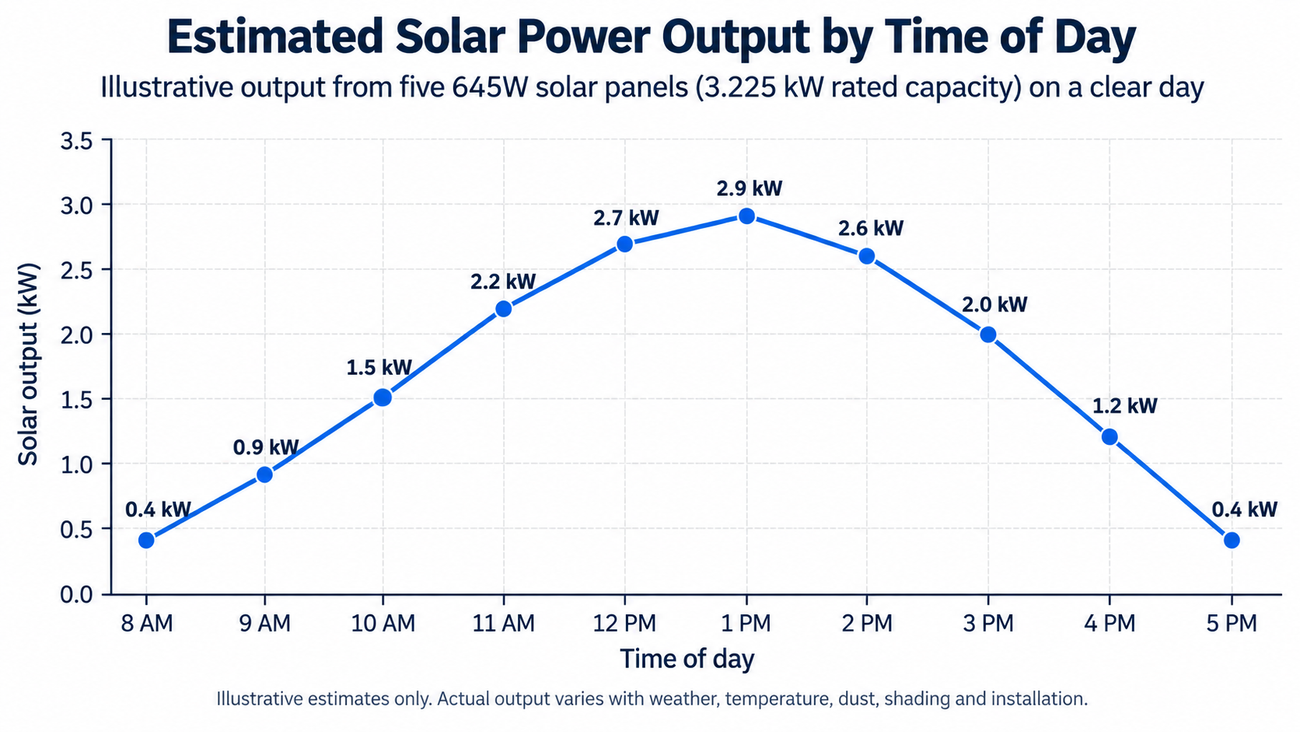
Solar panels do not generate the same amount of electricity every hour. Production typically increases after sunrise, peaks around midday, and decreases toward sunset.
The following graph illustrates the estimated power output of a 3.225 kW solar array consisting of five 645W panels on a sunny day in Pakistan. These figures are illustrative averages for explanation, not a live forecast or guaranteed output.
Estimated Solar Power Output by Time of Day
Illustrative output from five 645W panels (3.225 kW rated capacity) on a clear day. Actual output varies with weather, heat, dust and shading.
What Does This Graph Mean for Your AC?
- 8 AM–10 AM: Solar output is building up. The grid or battery may need to support the AC.
- 10 AM–12 PM: Production increases, so solar can supply more of the AC’s demand.
- 12 PM–2 PM: Output is near its daily peak under favourable conditions.
- 2 PM–4 PM: Production gradually decreases, even if the weather remains sunny.
- After sunset: Solar panels stop producing useful electricity. You need grid power or a suitable battery system to run the AC.
A 3.225 kW array may generate roughly 13–16 units of electricity over a good sunny day under favourable conditions, but seasonal conditions and system losses can change this significantly. Also, daily energy production and instantaneous power are different measurements. The AC needs sufficient power while it is running, not just enough energy accumulated over the day.
Which Solar Panels Are Best for Running an AC?
High-efficiency modules can be useful when roof space is limited. Two options to consider are AIKO’s high-wattage modules and LONGi’s Hi-MO X10 series.
These high-wattage panels can help deliver substantial rated capacity with fewer modules. Verify exact model, efficiency, and electrical specifications before ordering.
This high-efficiency module uses LONGi’s HPBC 2.0 back-contact cell technology. The listed 645W model has an efficiency of about 23.9%. 【turn716067search8】
Why Consider These High-Efficiency Solar Modules?
Both options can suit residential solar projects when their specifications match the system design.
- Higher rated wattage: More installed capacity from each panel.
- Better use of roof space: You may need fewer modules to reach a target system size.
- Potentially strong daytime generation: Useful for running inverter ACs when sunlight is available.
- Careful model selection: Panel specifications, temperature behaviour, and inverter compatibility matter.
Remember that no panel can guarantee the same output in every season. High temperatures, clouds, dirt, and shading can reduce production. A professional installer should check the inverter’s electrical limits and design the panel strings accordingly.
Can You Run an AC on Solar Without Batteries?
Yes. A properly designed on-grid or hybrid solar system can operate an AC during daylight without a battery, depending on the system configuration and available power.
However, there are important differences:
- On-grid solar: Solar provides power, and the grid can cover any shortfall. A standard grid-tied system normally shuts down during a power outage for safety.
- Hybrid solar: A compatible hybrid inverter can combine solar, battery power, and grid electricity.
- Off-grid solar: You need a suitably sized inverter and battery bank to keep operating when sunlight is unavailable.
If you want to run an AC at night, calculate the battery capacity based on the AC’s actual energy consumption and how many hours you need it to run. Do not size a battery using the AC’s tonnage alone.
Where Can You Buy Original Solar Panels at Wholesale Rates in Pakistan?
For solar installers, dealers, and homeowners, buying authentic panels at competitive prices is just as important as choosing the right wattage.
Hajvery Solar Energy supplies solar panels, inverters, and batteries for residential and commercial projects. Customers can enquire about the availability and wholesale rates of AIKO high-wattage panels and LONGi Hi-MO X10 modules.
solar panels loading
Visit the New Hajvery Solar Energy Warehouse in Gujrat
Hajvery Solar Energy has also opened a new warehouse on Naat Road, Gujrat, turning it into a convenient option for customers and solar dealers looking to source solar equipment.
Before purchasing, ask the sales team to check the exact panel model, serial numbers, documentation, warranty terms, and current wholesale price. Verify authenticity through the manufacturer’s official verification process where available.
- Business: Hajvery Solar Energy
- New warehouse: Naat Road, Gujrat
- Website: hajverysolar.com
- Contact: 0345-5652278
Dealers purchasing in bulk should request a quotation based on the required panel quantity and delivery location. This helps them accurately calculate project costs.
Frequently Asked Questions
How many solar panels do I need for a 1.5-ton inverter AC?
Five 645W or 665W panels are a practical starting point for daytime operation. The final quantity depends on the AC’s electrical consumption, sunlight, and other connected loads.
Can five 665W solar panels run a 1.5-ton AC?
Five panels provide 3.325 kW of rated solar capacity. This can be sufficient under favourable conditions, but actual production varies. You may need a compatible inverter and grid or battery backup when solar output falls below the AC’s demand.
How many panels do you need for a 1-ton AC?
Three to four high-wattage panels are a reasonable initial estimate for an efficient inverter AC. Check the manufacturer’s power-input specifications before finalising the system.
How many panels do you need for a 2-ton AC?
Seven to eight 645W or 665W panels provide approximately 4.5–5.3 kW of rated capacity. You may need a larger array for a high-consumption AC or additional appliances.
Which is better for an AC system: AIKO 665W or LONGi Hi-MO X10 645W?
Both are worth considering. Compare the exact model’s efficiency, price, warranty, authenticity, and compatibility to your inverter. The higher wattage of the AIKO option does not automatically make it the better purchase for every roof or budget.
Final Recommendation
For most households planning a daytime solar system, start with five AIKO 665W or LONGi Hi-MO X10 645W panels for a 1.5-ton inverter AC. Consider three to four panels for a 1-ton AC and seven to eight for a 2-ton model.
These are planning estimates rather than guarantees. Before buying, check the AC’s maximum electrical input, calculate the expected solar production, and decide whether you need grid or battery backup.
For original solar panels and wholesale quotations, contact Hajvery Solar Energy through hajverysolar.com or enquire about the new warehouse on Naat Road, Gujrat.
 Crown
 FUJI
 INVENT
 INVT (CHF)
 VEICHI
 EVE
 INVEREX