
Blog
LONGi 645W Hi-MO X10 Bifacial vs Jinko 645W Tiger Neo: Which Is Better?
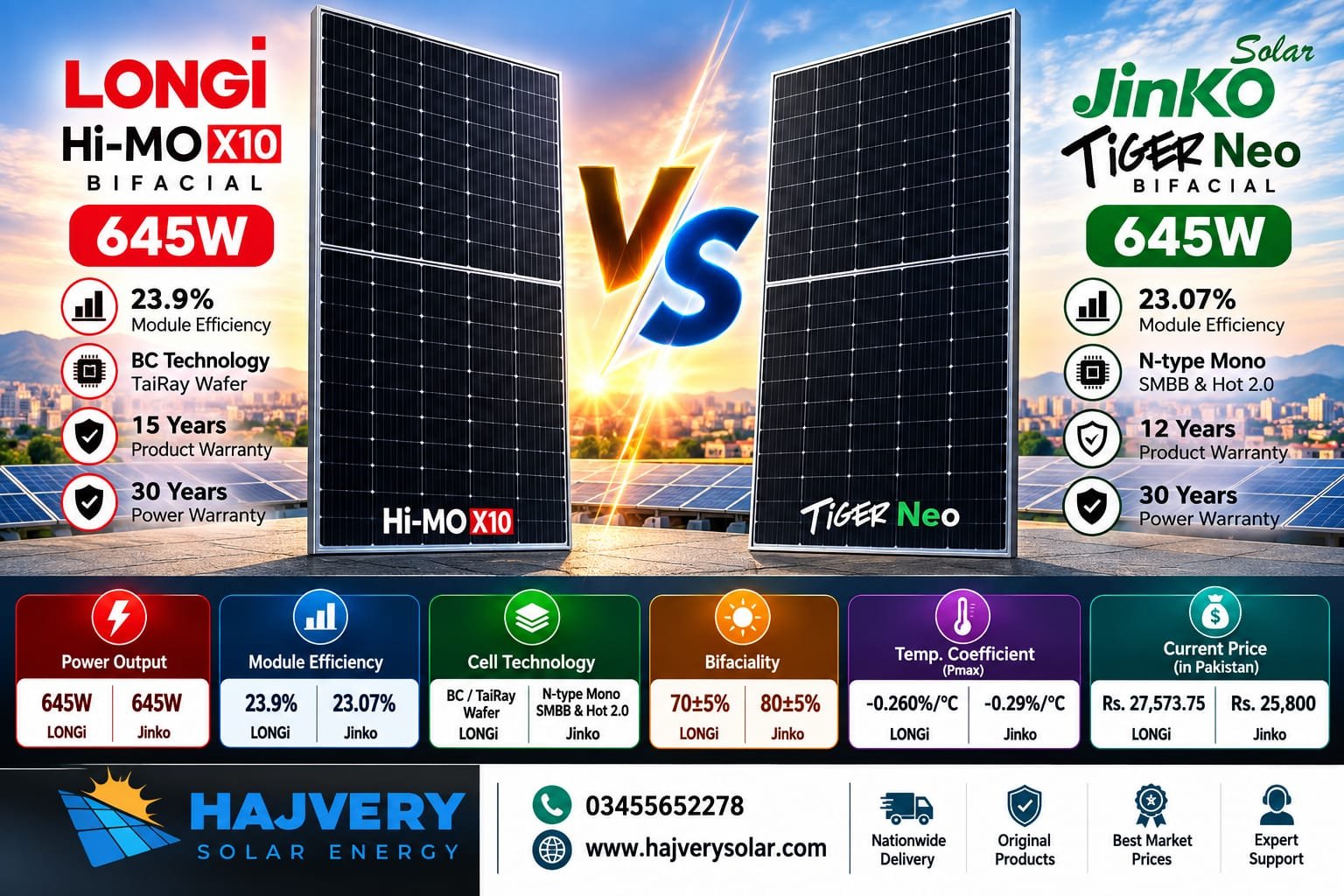
When choosing a high-power solar panel in Pakistan, “LONGi vs Jinko: which is better?” is a common question. Both brands offer advanced N-type bifacial technology, but their 645W panels differ in cell technology, efficiency, warranties, and pricing.
The LONGi Hi-MO X10 645W Bifacial uses BC cell technology and TaiRay wafers, while the Jinko Tiger Neo 645W Bifacial uses N-type monocrystalline cells with SMBB and Hot 2.0 technology.
LONGi 645W vs Jinko 645W Comparison
| Specification | LONGi Hi-MO X10 645W Bifacial | Jinko Tiger Neo 645W Bifacial |
|---|---|---|
| Current price | Rs. 27,573.75 | Rs. 25,800 |
| Power output | 645W | 645W |
| Module efficiency | 23.9% | 23.07% |
| Cell technology | BC / TaiRay wafer | N-type Mono, SMBB & Hot 2.0 |
| Bifaciality | 70±5% | 80±5% |
| Pmax temperature coefficient | -0.260%/°C | -0.29%/°C |
| First-year degradation | <1% | Included in 30-year performance warranty |
| Annual degradation | 0.35% from years 2–30 | 0.40% |
| Product warranty | 15 years | 12 years |
| Power warranty | 30 years | 30 years |
| Maximum system voltage | 1500V | 1500V |
| Weight | 33.5kg | 34kg |
| Dimensions | 2382 × 1134 × 30mm | 2465 × 1134 × 30mm |
The listed prices differ by about Rs. 1,774 per panel, with Jinko currently costing less. Hajvery Solar Energy lists the LONGi 645W at Rs. 27,573.75 and the Jinko 645W at Rs. 25,800.
Efficiency and Performance
LONGi has an advantage in front-side efficiency. Its 645W X10 reaches 23.9% efficiency, compared with 23.07% for the Jinko 645W. LONGi also specifies a Pmax temperature coefficient of -0.260%/°C, while Jinko specifies -0.29%/°C. These specifications can matter in Pakistan’s hot climate because panels lose output as cell temperature rises.
However, Jinko offers a higher stated bifaciality of 80±5%, compared with LONGi’s 70±5%. This can make Jinko particularly interesting for installations with good rear-side light conditions.
Technology and Warranty
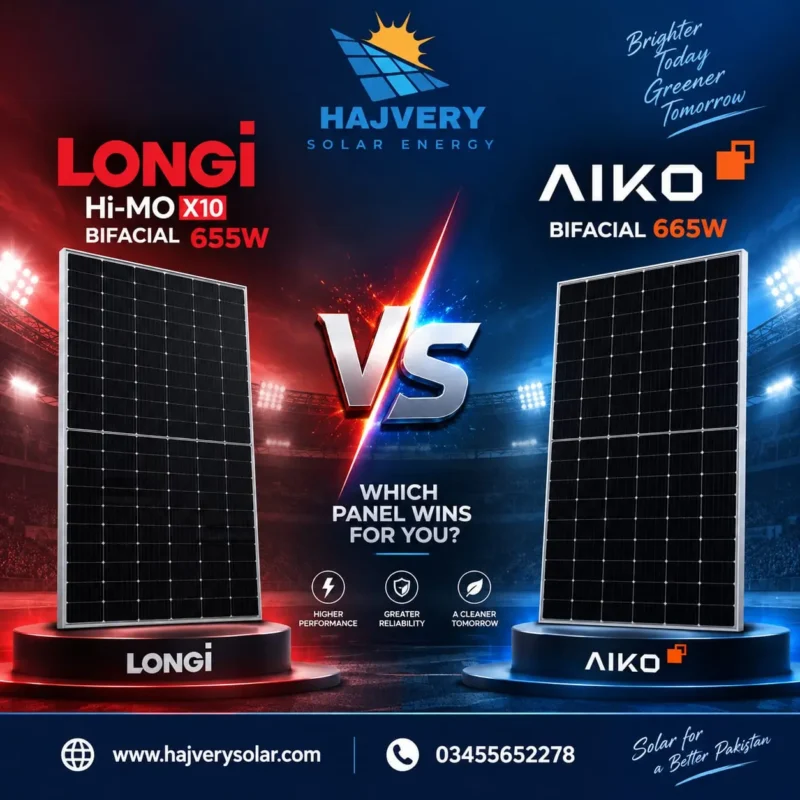
The LONGi X10 vs Jinko N-type comparison and the LONGi X10 vs aiko 665W comparison show different approaches to N-type technology. LONGi uses BC technology and TaiRay wafers, while Jinko uses SMBB and Hot 2.0 technology. Both panels feature dual-glass construction and support 1500V systems.
LONGi provides a 15-year product warranty and a 30-year linear power warranty. Jinko provides a 12-year product warranty and a 30-year linear power warranty. LONGi’s datasheet specifies less than 1% first-year degradation and 0.35% annual degradation from years 2–30, while Jinko specifies 0.40% annual degradation over 30 years.
Price in Pakistan
For buyers researching Longi vs Jinko price in Pakistan, current Hajvery Solar listings show Jinko at a lower upfront price. The difference becomes significant when purchasing dozens or hundreds of panels for a commercial installation.
Other brand comparisons, such as Jinko vs LONGi vs Canadian Solar (which is better), Jinko vs Canadian Solar (which is better), and Jinko vs LONGi vs Trina, require comparing exact models rather than judging brands as a whole.
Conclusion: LONGi or Jinko?
For this specific 645W comparison, LONGi Hi-MO X10 offers the stronger specification package for buyers who prioritize higher front-side efficiency, a better temperature coefficient, lower stated degradation, and a longer product warranty. Jinko, however, offers a lower purchase price and higher stated bifaciality, which can make it attractive for projects where rear-side energy gain and initial cost matter more.
Therefore, when comparing these two models, the LONGi 645W is the better choice for maximum efficiency and long-term specification advantages, while the Jinko 645W can offer better upfront value. Buyers should also consider installation conditions, rear-side reflection, available space, inverter compatibility, warranty support, and the latest market price before purchasing.
 Crown
Crown FUJI
FUJI INVENT
 INVT (CHF)
 VEICHI
 EVE
EVE INVEREX