
Blog
China Solar Panel Export Ban 2027: Impact on Pakistan
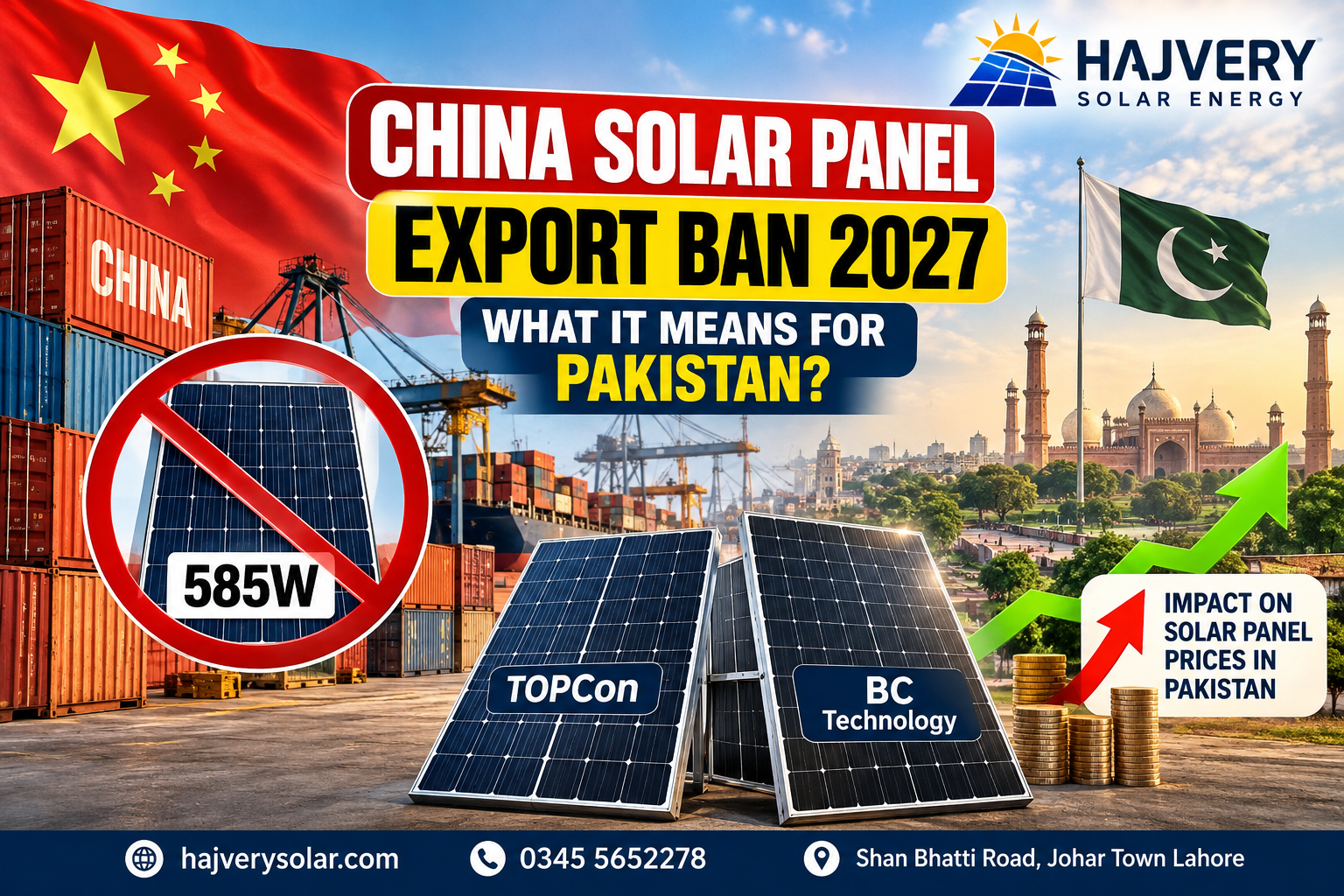
China is preparing major changes to its solar manufacturing industry, and these developments could influence solar panel prices, technology choices and supply chains worldwide. In Pakistan, where imported solar modules play a major role in residential, commercial and industrial installations, buyers are asking whether China is banning 585W solar panels and whether prices will increase in 2027.
The answer depends on three developments: China’s new mandatory solar module efficiency standards, its proposed controls on exporting advanced solar manufacturing technologies, and changes to export tax rebates.
These measures can reshape the solar industry. However, they do not all impose the same restrictions on finished solar panels.
Why Is China Changing Its Solar Panel Policy in 2027?
China has developed the world’s largest solar manufacturing supply chain. However, intense competition, excess manufacturing capacity, and falling prices have squeezed manufacturers’ profits.
In response, Chinese authorities have introduced new product standards and proposed additional controls on selected manufacturing technologies. The measures intend to improve product quality, reduce inefficient production, and protect strategically important technologies.
According to industry reporting, China’s new mandatory efficiency standards for photovoltaic products will take effect in stages during 2027. Three energy-efficiency standards are scheduled to take effect on January 1, 2027, while module safety and labelling requirements are scheduled for June 1, 2027—source: PV Tech.
The government has also proposed export controls covering selected solar manufacturing technologies, including certain TOPCon, back-contact (BC) and heterojunction (HJT) production processes. These proposals concern manufacturing know-how and equipment, not a blanket prohibition on finished solar modules. Source: Reuters.
1. Phasing Out Lower-Efficiency Solar Modules
One major development is China’s new minimum efficiency framework for crystalline-silicon solar modules.
Industry reporting on the standards identifies minimum conversion efficiencies of 23.2% for TOPCon and HJT modules and 23.5% for BC modules. Such thresholds could affect products that fail the relevant requirements when sold in China’s domestic market—source: PV Tech.
The purpose is not simply to increase the wattage printed on a solar panel. The policy also encourages manufacturers to improve conversion efficiency, product quality and traceability.
For buyers, however, one question matters most: will a 585W solar panel remain available?
2. Is China Banning 585W Solar Panels?
The claim that China is banning every 585W solar panel for export is misleading.
The new efficiency requirements apply to products within their scope in China’s domestic market. Official guidance clarifies that solar products manufactured for export are treated separately and may follow the technical specifications agreed between manufacturers and overseas buyers.
Therefore, a 585W module that does not meet China’s domestic requirements is not automatically prohibited from being exported to Pakistan—source: OPIS.
Nevertheless, manufacturers may change their production plans. Some could reduce lower-efficiency product lines, introduce newer models or focus more heavily on high-efficiency modules.
This distinction is important for anyone searching for a China solar panel ban in 2027. A change in domestic market access does not automatically mean an export ban.
3. Which Solar Manufacturing Technologies Could Face Export Controls?
China has proposed controls on selected manufacturing technologies used to produce solar wafers and cells.
The proposed measures cover specific technologies and technical thresholds, not every product in a category. They include certain TOPCon, BC, and HJT manufacturing technologies, along with selected advanced wafer, polysilicon, and perovskite processes.
Some technologies are proposed for prohibition, while others would face restrictions and potential licensing requirements. The scope depends on the technical specifications set out in the proposal.
The consultation period for the proposed changes runs until November 15, 2026, so buyers should check the final rules before forming assumptions about long-term availability—source: OPIS.
These controls could affect companies seeking to establish solar manufacturing facilities outside China. They do not, by themselves, mean that Chinese manufacturers must stop exporting ordinary TOPCon or BC solar panels.
Which Solar Panels Could Be Affected?
The effect depends on the distinction between module-efficiency standards and manufacturing-technology controls.
585W TOPCon Solar Panels
Many 585W modules use N-type TOPCon cells. These panels remain popular because they preserve efficiency, price, and availability.
For example, Canadian Solar and Astronergy offer 585W TOPCon bifacial modules. Their current specifications and prices reflect what Pakistani buyers are purchasing today.
A panel’s wattage alone does not determine whether it complies with a standard. Cell technology, conversion efficiency, dimensions, model certification, and intended market also matter.
585W BC and Other Back-Contact Panels
Back-contact technology places electrical contacts on the rear side of the cell. This design can reduce front-side shading from metal contacts and support high conversion efficiency.
However, not all BC products perform the same. Manufacturers use different cell architectures, so check the applicable efficiency standard for the exact model.
Higher-efficiency BC panels may become more attractive as manufacturers launch new product generations. Yet the proposed controls on BC manufacturing technology should not be confused with a ban on finished BC modules.
HJT Solar Panels
Heterojunction technology combines crystalline silicon with thin amorphous-silicon layers. It can deliver high efficiency and favourable temperature performance.
Selected HJT manufacturing technologies may fall within China’s proposed export-control framework. This could complicate overseas factory development and technology licensing.
However, the proposal does not establish that all HJT panels will disappear from international markets.
What Will Happen to Solar Panel Prices in Pakistan?
Pakistan relies heavily on imported solar panels. Consequently, changes in Chinese manufacturing costs, export policies, freight charges and the rupee exchange rate can influence local prices.
However, no single policy determines the entire market. Existing stock, brand competition, international demand, and dealer inventory also affect prices.
Will 585W Solar Panels Become More Expensive?
There are several possible outcomes.
First, manufacturers may shift more production to higher-efficiency products. If manufacturers gradually discontinue lower-efficiency models, buyers may find fewer choices in certain wattage categories.
Second, manufacturers could face additional costs from tax changes or alterations to their export operations. Some of these costs may pass through to overseas buyers.
Third, demand may turn towards higher-wattage modules. This could narrow the price gap between older 585W panels and newer 630W, 650W, or 700W-plus products.
However, it would be inaccurate to predict that every 585W panel will rise in price by a fixed percentage. Market oversupply and competition could offset some cost increases.
China’s Solar Export Tax Rebate Changes
Another important development is China’s removal of export VAT rebates for solar products from April 1, 2026.
This is separate from the 2027 efficiency standards. Removing the rebate can increase the effective cost of exporting eligible products and put pressure on manufacturers’ margins. Exporters may respond by renegotiating prices, absorbing some of the cost or changing their sales strategies.
The actual effect on Pakistan depends on the product, supplier, contract and commercial conditions—source: Jiemian Global.
Current Solar Panel Prices in Pakistan: TOPCon vs BC Technology
The following prices are published listings from Hajvery Solar Energy and provide a useful market reference for Pakistani buyers.
Prices can change with stock, shipment costs, exchange rates and dealer quotations. Confirm the current rate and availability before placing an order.
| Solar panel | Technology | Listed price per panel | Price per watt |
| Canadian Solar 585W bifacial | N-type TOPCon | Rs. 23,546.25 | Rs. 40.25 |
| Astronergy 585W bifacial | N-type TOPCon | Rs. 22,083.75 | Rs. 37.75 |
| LONGi 585W bifacial | HPDC | Rs. 23,400 | Rs. 40.00 |
| AIKO 665W bifacial | N-type ABC (BC) | Rs. 28,528.50 | Rs. 42.90 |
Sources: Canadian Solar 585W, Astronergy 585W, LONGi 585W and AIKO 665W.
The LONGi listing uses HPDC technology, so it should not automatically be classified as a conventional TOPCon module. Likewise, AIKO ABC is a specific back-contact architecture.
The prices above are product listings, not a guarantee of stock or a universal market rate. Check the product pages for the latest availability.
TOPCon Solar Panel Price in Pakistan
TOPCon panels are widely used in residential and commercial solar systems because they combine relatively high efficiency with competitive manufacturing costs.
The examples above list selected 585W TOPCon panels at approximately Rs. 37.75 to Rs. 40.25 per watt.
TOPCon panels suit buyers who want to balance upfront cost, output, and long-term performance. However, buyers should compare warranty terms, temperature coefficients, bifaciality, mechanical specifications and genuine product documentation.
BC Solar Panel Price in Pakistan
BC technology appeals to buyers who want higher efficiency in a limited installation area.
The listed AIKO 665W ABC panel costs Rs. 28,528.50, equivalent to Rs. 42.90 per watt. Its listed module efficiency is 24.6%.
Although its per-watt price is higher than the two TOPCon examples, buyers should not judge value by price alone. A proper comparison also considers usable roof space, total installed capacity, expected generation, and the system’s design.
TOPCon vs BC Solar Panels: Which Technology Is Better?
Both technologies can provide excellent performance. The better choice depends on the installation and the buyer’s budget.
Advantages of TOPCon Technology
- Competitive upfront prices across many product ranges.
- Wide availability in different power ratings.
- Good efficiency and bifacial options.
- Established supply chains and broad product selection.
TOPCon can be a sensible option for large rooftops and ground-mounted projects where cost per watt is a major consideration.
Advantages of BC Technology
- High conversion efficiency in leading product ranges.
- Greater power density for some models.
- Reduced front-side shading from cell metallisation.
- Possible benefits where roof space is limited.
BC technology can be attractive for premium residential and commercial installations where additional capacity from a fixed roof area is valuable.
Which One Should Pakistani Buyers Choose?
Compare equivalent product classes and verified datasheets, not just a 585W TOPCon panel with a 665W BC panel.
A fair assessment should include:
- Price per watt and total purchase cost.
- Module efficiency and dimensions.
- Temperature coefficient and expected energy yield.
- Product and performance warranties.
- Degradation, mechanical ratings and bifacial performance.
- Availability of genuine stock and manufacturer support.
A higher-wattage panel does not automatically generate proportionally more electricity in every system. System layout, shading, orientation and operating temperature also matter.
How Could China’s Policy Changes Affect Pakistan’s Solar Market in 2027?
Pakistan could experience several market changes as manufacturers adapt to the new standards and proposed technology controls.
1. More High-Efficiency Solar Panels
Manufacturers may increasingly focus on higher-output modules. Pakistani buyers could see more high-efficiency TOPCon and BC panels, though availability will depend on each manufacturer’s plans.
2. Changes in the Price Difference Between Technologies
If production costs rise or the product mix changes, the price gap between TOPCon and BC panels could widen or narrow. Competition, manufacturing scale, and supply conditions will shape the outcome.
3. Pressure on Older Product Lines
Some lower-efficiency models could become harder to source if manufacturers reduce production. However, China treats export products separately under its domestic standards, so a domestic phase-out does not automatically prohibit imports into Pakistan.
4. Greater Importance of Product Verification
Buyers should verify serial numbers, datasheets, warranty documents and model specifications. They should also confirm that the delivered panel matches the quoted model and advertised technology.
For distributors, this is an opportunity to educate customers about the difference between genuine high-efficiency products and modules with misleading specifications.
5. Possible Short-Term Price Volatility
Changes to export costs and production plans could cause temporary price movements. Nevertheless, global oversupply, competing manufacturers and local inventory may limit increases.
Therefore, buyers must avoid making buying choices based only on rumours of an immediate solar panel shortage.
What Should Solar Distributors and Importers Do Now?
Solar distributors in Pakistan should monitor both finished-module availability and changes affecting manufacturing technology exports.
Before committing to a large shipment, buyers should:
- Validate the exact model and cell technology.
- Request a current manufacturer datasheet and warranty.
- Obtain written pricing and delivery terms.
- Confirm the product’s origin and documentation.
- Compare available inventory across several manufacturers.
- Review contracts for delivery dates and price-adjustment clauses.
For distributors selling LONGi, Canadian Solar, AIKO, Jinko, JA Solar and other major brands, maintaining a mix of suitable product options can reduce dependence on a single model or wattage category.
Frequently Asked Questions
Is China banning 585W solar panels in 2027?
China’s new domestic efficiency standards may affect modules that don’t meet the requirements. However, official guidance treats export-bound products separately. There is no basis to claim that every 585W panel is automatically banned from export to Pakistan.
Which solar panels will be banned for export from China?
The proposed export controls target selected manufacturing technologies and associated equipment, including certain advanced TOPCon, BC and HJT processes. They do not impose a blanket ban on finished solar panels made with those technologies.
Will TOPCon solar panel prices increase in Pakistan?
Prices could rise if export costs increase or supply shifts. However, the outcome will also depend on competition, existing inventory, exchange rates and international demand.
Are BC solar panels better than TOPCon panels?
BC panels can offer higher efficiency in certain product ranges, while TOPCon panels often offer competitive prices and broader availability. Buyers should compare the exact models, warranties, dimensions and expected energy yield.
Should I buy a 585W solar panel now or wait for 2027?
There is no universal answer. A suitable 585W panel can still provide reliable service if it is genuine, properly documented, and right for the system. Buyers should assess current prices, stock and project requirements rather than assuming that every 585W module will become unavailable.
Where can I check solar panel prices in Pakistan?
You can review current product listings and availability on Hajvery Solar Energy. Prices can change, so confirm the latest quotation before purchasing.
Conclusion
China’s solar policy changes matter for Pakistan, but the details matter more. The 2027 domestic efficiency standards, proposed controls on manufacturing technology exports and removal of solar export VAT rebates are separate measures with different effects.
Some lower-efficiency products may face tighter domestic market access, while selected advanced manufacturing technologies may require additional export permissions. Neither development means that every 585W TOPCon or BC solar panel is automatically banned from export.
For Pakistani buyers, the practical approach is to compare verified product specifications, current prices, warranty support and availability. TOPCon remains a competitive choice for many projects, while high-efficiency BC panels may offer added value where space is limited.
As the rules develop, reliable documentation and current supplier quotations will be more useful than unconfirmed claims about a blanket solar panel ban.
 Crown
 FUJI
 INVENT
 INVT (CHF)
 VEICHI
 EVE
 INVEREX