Bifacial Solar Panels in Pakistan: Benefits, Drawbacks, and Which Panels Are Better?
Solar energy is becoming increasingly popular in Pakistan as households and businesses look for ways to reduce electricity bills. However, choosing the right solar panel can be confusing. Many buyers compare monofacial and bifacial solar panels without understanding their performance, installation requirements, and overall costs.
In this guide, we explain the difference between both technologies, their advantages and disadvantages, and which option offers better value for money in Pakistan.
Monofacial solar panels generate electricity from sunlight reaching their front surface. Their rear side usually has an opaque protective backsheet that protects the solar cells from moisture, dust, and environmental damage.
These panels use modern monocrystalline technologies, including TOPCon and other advanced cell designs. Their performance depends on factors such as panel efficiency, sunlight exposure, temperature, shading, and installation quality.
What Are Monofacial Solar Panels?
A typical monofacial panel uses glass on the front and a protective polymer backsheet on the rear. However, single-glass construction does not automatically mean lower quality or outdated technology.
Advantages of Monofacial Solar Panels
Excellent rooftop performance: They work well on ordinary concrete rooftops without requiring reflected sunlight.
Lower upfront cost: They can be more affordable than comparable bifacial models.
Simpler installation: Standard mounting structures are generally sufficient.
Modern technology: Buyers can choose high-efficiency panels from reputable manufacturers.
Straightforward maintenance: There is no need to maintain a reflective roof specifically for rear-side electricity generation.
Disadvantages of Monofacial Solar Panels
They cannot generate electricity from sunlight reaching the rear side.
They may produce less electricity than comparable bifacial panels under favourable reflective conditions.
They may not offer the same potential benefits for elevated structures where sunlight can reach both sides.
What Are Bifacial Solar Panels?
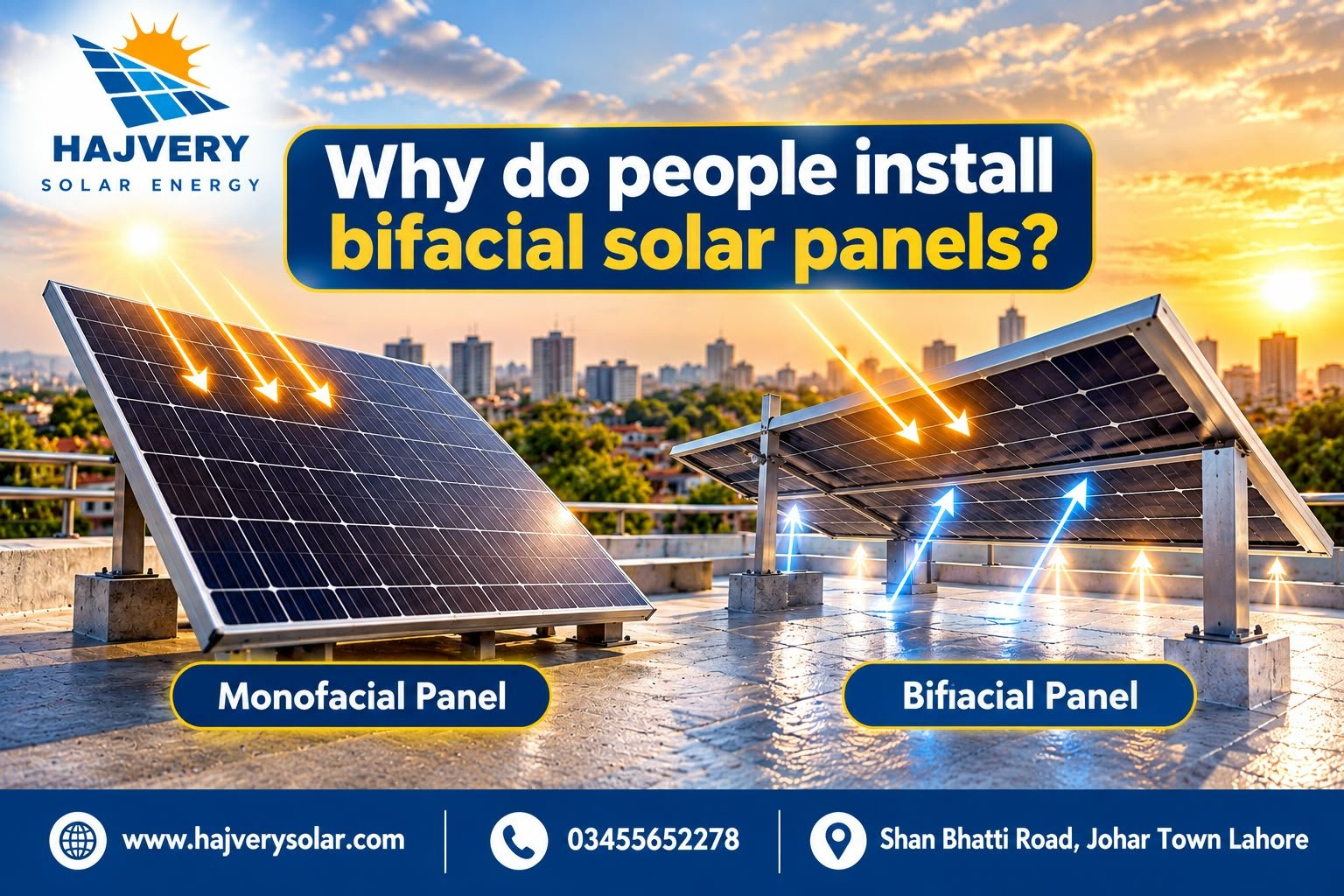
Bifacial solar panels generate electricity from both their front and rear surfaces. The front captures direct sunlight, while the rear can absorb reflected and scattered light from the surrounding environment.
Many bifacial panels use double-glass construction, although some models use other rear-side materials. Buyers should check the manufacturer’s specifications before selecting a particular panel.
How Do Bifacial Solar Panels Generate More Electricity?
The additional electricity comes from light reaching the rear surface. The amount depends on several factors:
Roof colour and surface reflectivity
Panel height above the roof
Tilt angle and mounting arrangement
Spacing between panels and rows
Shadows and obstructions behind the panels
White roofs, light-coloured concrete, and other reflective surfaces can improve rear-side performance. However, bifacial panels do not guarantee a fixed percentage increase in electricity generation.
Advantages of Bifacial Solar Panels
Potentially higher energy generation: The rear side can capture additional reflected sunlight.
Suitable for commercial projects: Elevated installations and ground-mounted solar farms may benefit significantly.
Better use of reflected light: Suitable reflective surfaces can improve overall energy production.
Durable construction options: Some double-glass models offer robust protection, depending on their design and specifications.
Disadvantages of Bifacial Solar Panels
Extra generation is not guaranteed: Rear-side output depends on the installation environment.
Potentially higher installation costs: Special mounting arrangements and additional clearance may increase expenses.
Reflective surfaces may cost more: White roof paint or reflective coverings require investment and maintenance.
More planning is required: Installers must consider rear-side shading, mounting height, and panel spacing.
Limited benefits on some rooftops: Panels mounted close to a dark surface may receive little reflected light.
Monofacial vs Bifacial Solar Panels: Comparison Table
The following table compares the main features of both solar panel types for Pakistani homes and businesses.
Feature
Monofacial Panels
Bifacial Panels
Electricity generation
Front side
Front and rear sides
Cell technology
Modern technologies available
Modern technologies available
Glass construction
Usually front glass and rear backsheet
Often double glass
Standard rooftop suitability
Excellent
Depends on rear-light exposure
White roof required
No
No, but it can help
Additional rear-side output
Not applicable
Depends on installation
Mounting requirements
Often simpler
Clearance may be important
Maintenance
Generally straightforward
Rear-side access may be needed
Best applications
Homes and standard rooftops
Reflective rooftops and suitable commercial sites
Value for money
Excellent when priced competitively
Depends on additional energy generation
Note: Actual performance depends on the specific panel model, installation design, local conditions, and total installed cost.
Why Do People Install Bifacial Solar Panels in Pakistan?
Many Pakistani buyers choose bifacial panels because they expect higher wattage, improved efficiency, and more electricity from the same installation area. Commercial installers may also prefer these panels for elevated solar arrays and large ground-mounted projects.
However, a panel’s advertised wattage normally refers to its front-side output under standard test conditions. Any additional rear-side electricity depends on the actual installation.
Are Bifacial Solar Panels Worth It on Pakistani Rooftops?
On a typical Pakistani rooftop, panels may sit relatively close to the roof surface. This arrangement can limit the amount of reflected light reaching their rear sides.
Consequently, the additional generation may be too small to justify paying a higher price. Buyers should compare the price difference with the expected annual electricity production rather than assuming that bifacial panels always perform better financially.
Does White Roof Paint Improve Bifacial Panel Performance?
White paint can increase roof reflectivity and help more light reach the rear side of bifacial panels. However, it does not guarantee a specific increase in electricity generation.
The results depend on the roof material, reflectivity, panel height, tilt angle, surrounding structures, and shading.
Before spending money on reflective coatings, ask your installer to estimate the likely energy gain and calculate whether the additional generation will recover the cost.
Which Solar Panels Are Better for Homes in Pakistan?
For most homeowners, the better choice depends on the price difference, installation conditions, and expected electricity generation.
Choose Monofacial Panels If:
You want to minimise the initial installation cost.
Your panels will be installed close to a conventional concrete roof.
You cannot provide sufficient clearance for rear-side light.
You want modern, high-efficiency technology without paying extra for a feature your installation may not use effectively.
Choose Bifacial Panels If:
Your roof or mounting structure allows reflected light to reach the rear side.
You are installing an elevated solar system or ground-mounted array.
Your project has suitable reflective surfaces.
An energy-yield calculation shows that the additional electricity justifies the higher total cost.
Final Verdict: Should You Install Monofacial or Bifacial Solar Panels?
For a standard residential rooftop in Pakistan, monofacial solar panels are often the more economical choice when comparable models cost less and rear-side generation would be limited. They can offer excellent performance with modern cell technology and straightforward installation.
Bifacial panels are not exclusively for industrial use. They can also be beneficial for residential systems when sufficient reflected light reaches the rear surface. Their additional generation is most valuable when the installation is specifically designed to capture that light.
Before paying extra for bifacial technology, compare efficiency, warranty, degradation rate, price per watt, and estimated annual energy production for both options.
Our recommendation:
Choose monofacial panels for a conventional rooftop when affordability is your priority. Consider bifacial panels when reflective surfaces, sufficient mounting clearance, and a realistic energy-yield calculation justify the additional investment.
The best solar panel is not necessarily the one with the most advanced design. It is the one that delivers reliable electricity and the best value for your specific installation.

 Crown
Crown FUJI
FUJI INVENT
 INVT (CHF)
 VEICHI
 EVE
EVE INVEREX