
Blog
LONGi Hi-MO X10 655W vs AIKO Stellar 3N+ 665W: Which Bifacial Panel Wins in Pakistan?
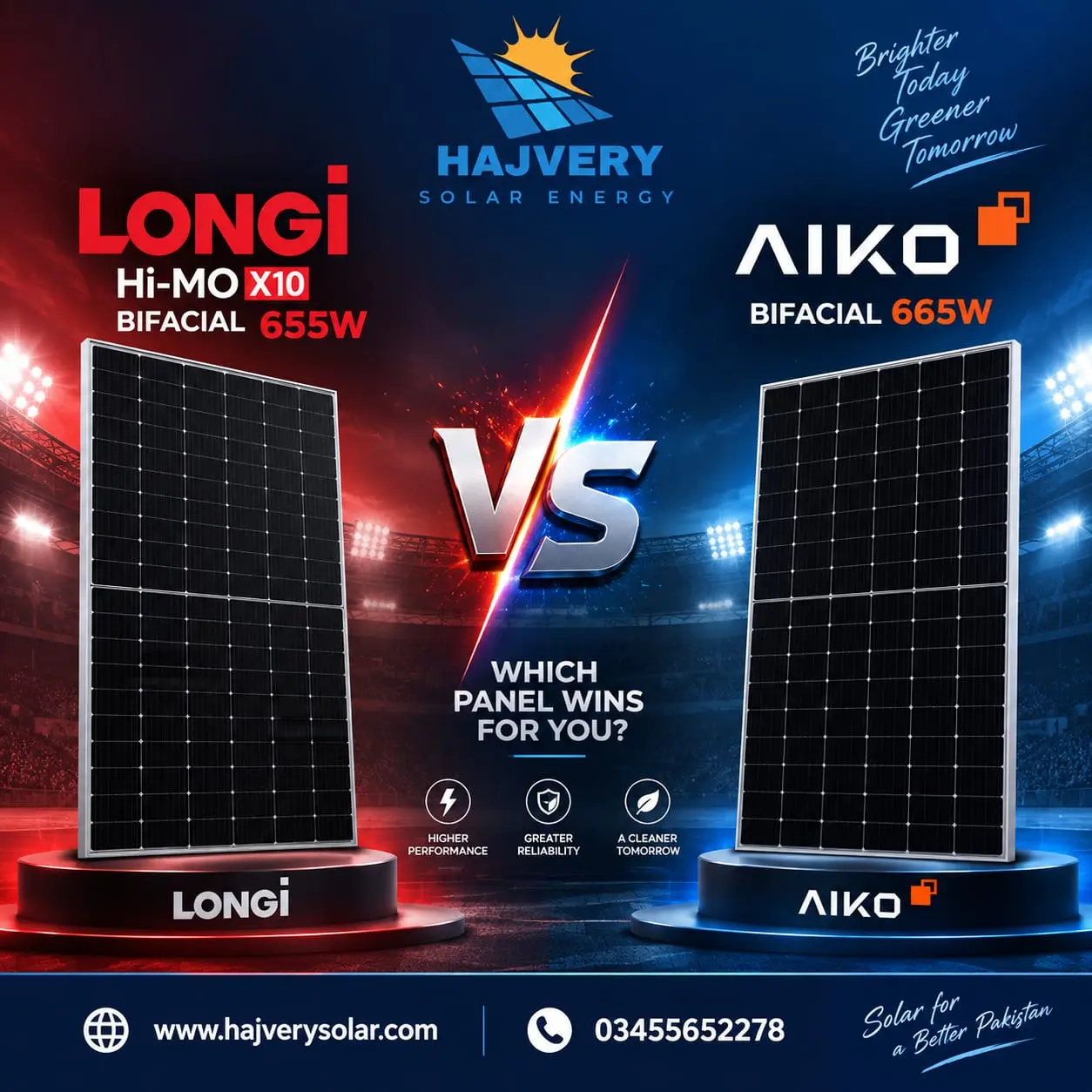
Pakistan’s solar market is making a serious shift toward high-efficiency N-type back-contact technology, and if you’re shopping around for panels right now, you’ve probably come across two names repeatedly: LONGi and AIKO. The LONGi Hi-MO X10 655W bifacial and AIKO Stellar 3N+ 665W bifacial are getting a lot of attention for good reason. Both use back-contact cell technology, come with dual-glass construction, offer 30-year performance warranties, and have incredibly low degradation rates. But here’s the thing: they’re built differently, and that matters when you’re trying to figure out which one makes sense for your installation.
Understanding the Key Differences in Cell Architecture
Let’s talk about how these panels are actually made, because that’s where the real story unfolds. The current Aiko Solar vs. Longi X10 specs show that both panels are designed for high power density, but their cell architectures diverge significantly. LONGi uses HPBC 2.0 technology paired with TaiRay wafers, whereas AIKO goes all-in with its N-type ABC (All Back Contact) architecture. These aren’t just fancy marketing terms; they genuinely affect how the panels perform in the field.
When you’re looking at bifacial solar panel technology specifically, understanding what “back-contact” means becomes crucial. Essentially, both manufacturers have moved all the electrical contacts to the rear of the cells, which gives you a completely clean front surface. No conventional front busbars, no shading issues from gridlines. It’s a clever design that lets more light hit the cell and generate more power.
Side-by-Side Specification Comparison
| Factor | LONGi Hi-MO X10 655W Bifacial | AIKO Stellar 665W Bifacial |
| Price in Pakistan | Rs. 28,165/panel; Rs. 43/W at Hajvery Solar | Rs. 28,595/panel; Rs. 43/W at Hajvery Solar |
| Watts | 655W | 665W |
| Module Efficiency | 24.25% | 24.6% |
| Rated Power Output | 655W | 665W |
| Temperature Coefficient (Pmax) | -0.26%/°C | -0.26%/°C |
| First-Year Degradation | ≤1% | ≤1% |
| Annual Degradation | ≤0.35%, Years 2–30 | ≤0.35%, Years 2–30 |
| Bifaciality Factor | 70 ±5% | 40%* |
| Product Warranty | 15 years | 15 years |
| Power Warranty | 30 years; 88.85% at Year 30 | 30 years; 88.85% at Year 30 |
| Cell Architecture & Wafer Technology | N-type HPBC 2.0 + TaiRay wafer | N-type ABC (All Back Contact) |
| Busbar Configuration | 0BB: no front gridlines and no conventional rear busbars | Back-contact/busbar-free front design |
| Cell Cutting & Layout | 144 cells, 6×24; half-cut architecture | 144 half-cells, 6×24 |
| Dimensions | 2382 × 1134 × 30 mm | 2382 × 1134 × 30 mm |
| Weight | 32.5 kg | 32.2 kg |
Price Comparison: You’ll Actually Pay
Here’s where it gets practical. The Aiko Solar vs. Longi X10 price in Pakistan is genuinely close; we’re not talking about massive differences. Hajvery Solar lists the LONGi 655W at Rs.28,165, while the AIKO 665W comes in at Rs.28,595. So you’re looking at only Rs.430 more for the AIKO, and you’re getting 10W additional rated output plus slightly higher module efficiency (24.6% versus 24.25%). That’s not a huge premium for the extra power you’re gaining.
However, here’s something important: shop around. HAJVERY SOLAR lists the AIKO 665W at Rs.29,260, which shows why you absolutely need to confirm the live quotation before placing your order. Prices shift constantly in Pakistan’s solar market, and what costs Rs.28,595 this month might be different next month.
Want to understand more about solar panel pricing in Pakistan? It’s worth checking out how different retailers price the same equipment.
The LONGi Hi-MO X10 655W Explained
The terms ‘longi himo x10′ and ‘longi hi-mo x10’ refer to LONGi’s latest back-contact module family, and honestly, the technology inside is pretty impressive. The X10 uses HPBC 2.0 cells combined with proprietary N-type TaiRay wafers and a 0BB (zero busbar) structure. What LONGi says matters here: this design eliminates front gridlines and conventional rear busbars, which means you’re reducing shading losses and cutting electrical transmission losses at the same time.
The manufacturer’s X10 documentation specifies a first-year degradation of 1%, followed by 0.35% annual degradation from Years 2 through 30, with a solid 30-year power warranty backing it up. The power temperature coefficient sits at -0.26%/°C, and this is genuinely important if you’re installing in Pakistan’s hot climate. When temperatures climb, panel output drops slightly, but LONGi’s coefficient shows they’ve engineered this to minimise that effect.
For anyone searching for the Longi Himo X10 price in Pakistan, the Longi Himo X10 price in Pakistan today, or the Longi Himo X10 bifacial price in Pakistan, the Hajvery listing provides a useful current reference point: Rs.28,165 for the 655W bifacial model at Rs.43/W. The Longi Himo X10 datasheet confirms the 144-cell configuration, 2382×1134×30 mm dimensions, and the -0.26%/°C Pmax coefficient. The same X10 family also shows up in other ratings models relevant to searches like longi himo x10 645w datasheet, longi himo x10 650w datasheet, and longi himo x10 645w exists too.
If you need to know the longi himo x10 size in feet or longi himo x10 dimensions, the manufacturer’s 2382×1134×30 mm spec translates to approximately 7.82 feet by 3.72 feet, with a thickness of about 1.18 inches. Pretty standard dimensions, honestly, which makes mounting straightforward on most rooftops.
AIKO Stellar 3N+ 665W Technology Deep Dive
AIKO’s 665W Stellar 3N+ uses N-type ABC technology, and here’s what that really means. All Back Contact (ABC) means AIKO moved electrical contacts to the rear of the cell entirely. The result? A completely clean front surface without conventional front busbars. The panel contains 144 cells arranged in a 6×24 layout with half-cut construction and dual 2 mm glass throughout. The efficiency rating is 24.6%, which puts it slightly ahead of the LONGi.
AIKO 665W datasheet gives the 665W model a -0.26%/°C power temperature coefficient (matching LONGi), ≤1% first-year degradation, and ≤0.35% annual degradation from Years 2–30. You also get a 15-year product warranty and a 30-year linear performance warranty. AIKO solar panel specifications are worth reviewing if you want the complete technical picture.
Searches like ‘Aiko solar panels price in Pakistan’, ‘Aiko solar panels price in Pakistan OXL’, ‘Aiko solar panel verification online’, ‘Aiko 680W solar panel price in Pakistan’, ‘Aiko 780 watt solar panel price in Pakistan’, ‘Aiko solar panel price in Islamabad’, ‘Aiko solar panel price in Rawalpindi’, and ‘Aiko solar panel dealer in Lahore’ are useful mainly for locating current market offers rather than determining technical performance. Keep that distinction in mind.
Solar Panel Efficiency
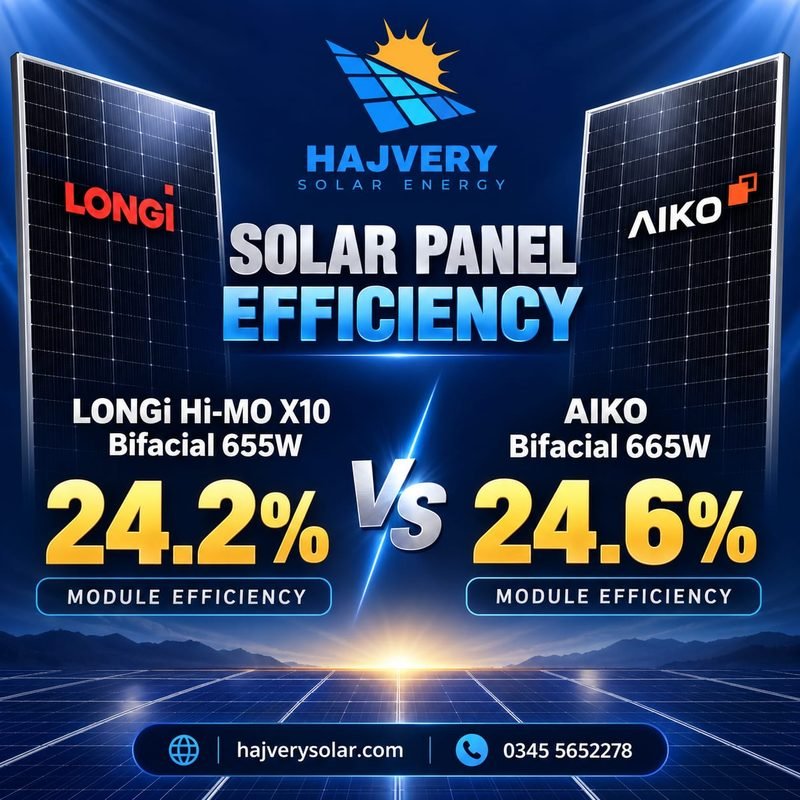
Solar panel efficiency shows how effectively a panel converts sunlight into usable electricity. In the case of the LONGi Hi-MO X10 655W and AIKO Stellar 3N+ 665W, both panels are designed to deliver high power output with advanced cell technology and bifacial performance. The AIKO Stellar 3N+ offers a higher rated power of 665W, while the LONGi Hi-MO X10 provides 655W of output. Actual energy production can vary depending on sunlight, temperature, installation angle, shading, and the amount of reflected light reaching the rear side of a bifacial panel. For solar installations in Pakistan, comparing both efficiency and real-world conditions is important when selecting a high-power panel.
LONGi X10 vs AIKO: The Important Differences That Matter
Let’s clear up one common confusion point right away. The LONGi S10 vs X10 comparison causes problems because the relevant current LONGi family is X10, not S10. Searches for the Longi S10 solar panel and the Longi S10 solar panel price shouldn’t be used as substitutes for the X10 655W datasheet. These are different product lines entirely.
Now, is LONGi X10 bifacial? Yes, the LR7-72HVD-655M we’re comparing here is a bifacial dual-glass X10 model with a listed 70±5% bifaciality factor. That’s a meaningful difference because AIKO’s bifaciality comes in at 40% for this exact model.
So here’s the reality: AIKO provides 10W greater front-side rated output and 0.35 percentage points higher module efficiency. LONGi, however, has the higher published bifaciality specification for these exact models we’re comparing. The actual rear-side gain depends heavily on mounting height, ground reflectivity, row spacing, and your specific installation geometry. Understanding bifacial panel installation is crucial before making your decision.
Real Talk: Which One Should You Choose?
Here’s the honest answer to “Which solar panel brand is better, AIKO or LONGi?”—it depends entirely on your application. Both manufacturers offer high-efficiency N-type back-contact modules. For you as a buyer, the meaningful comparison is model-to-model, including price, efficiency, bifaciality, warranty quality, authenticity, and your specific installation conditions.
Similarly, “Are Aiko solar panels the best?” depends completely on your criteria. AIKO’s 665W Stellar has high efficiency and solid ABC technology, but panel selection should factor in price, inverter compatibility, warranty support, and your site conditions too. Check out how to select the right solar panels for more guidance on this.
The frequently searched “What are the top 10 best solar panels in Pakistan?” isn’t actually a technical specification question; a universal list changes as prices, models, and availability shift constantly. What’s “best” for you depends on your roof area, budget, and specific needs.
For buyers researching the Longi Himo X10 price in Karachi today, Longi Himo X10 Bifacial, Longi Himo X10 price, or Longi 650w Himo 10, remember that the exact model number matters far more than the generic search term. Similarly, Aiko solar panel verification online should always use the panel’s serial number and authorised distribution documentation.
Making Your Final Decision
On the specifications compared here, these two panels are genuinely closely matched when it comes to long-term warranty, degradation rates, and temperature coefficients. AIKO’s 665W model provides 10W more rated power and 24.6% efficiency compared with LONGi’s 655W at 24.25%. The AIKO costs only Rs.430 more, according to current Hajvery Solar listings. Learn more about panel degradation and warranties to understand long-term value.
LONGi’s major differentiator is really its HPBC 2.0 + TaiRay + 0BB architecture combined with that higher published bifaciality specification for this particular model. AIKO’s major differentiator is its N-type ABC all-back-contact architecture and slightly higher front-side efficiency. Comparing bifacial panel technologies helps clarify these differences further.
Your actual choice should be based on your specific installation: available roof area, rear-side light availability, your mounting arrangement, inverter specifications, the current price at purchase time, and most importantly, the seller’s warranty and authenticity documentation. Both are technically advanced bifacial back-contact panels designed for Pakistan’s climate. Just remember to reconfirm the quoted prices before purchase. Pakistani solar panel prices change frequently, and you want to lock in the best deal.
 Crown
Crown FUJI
FUJI INVENT
 INVT (CHF)
 VEICHI
 EVE
EVE INVEREX