
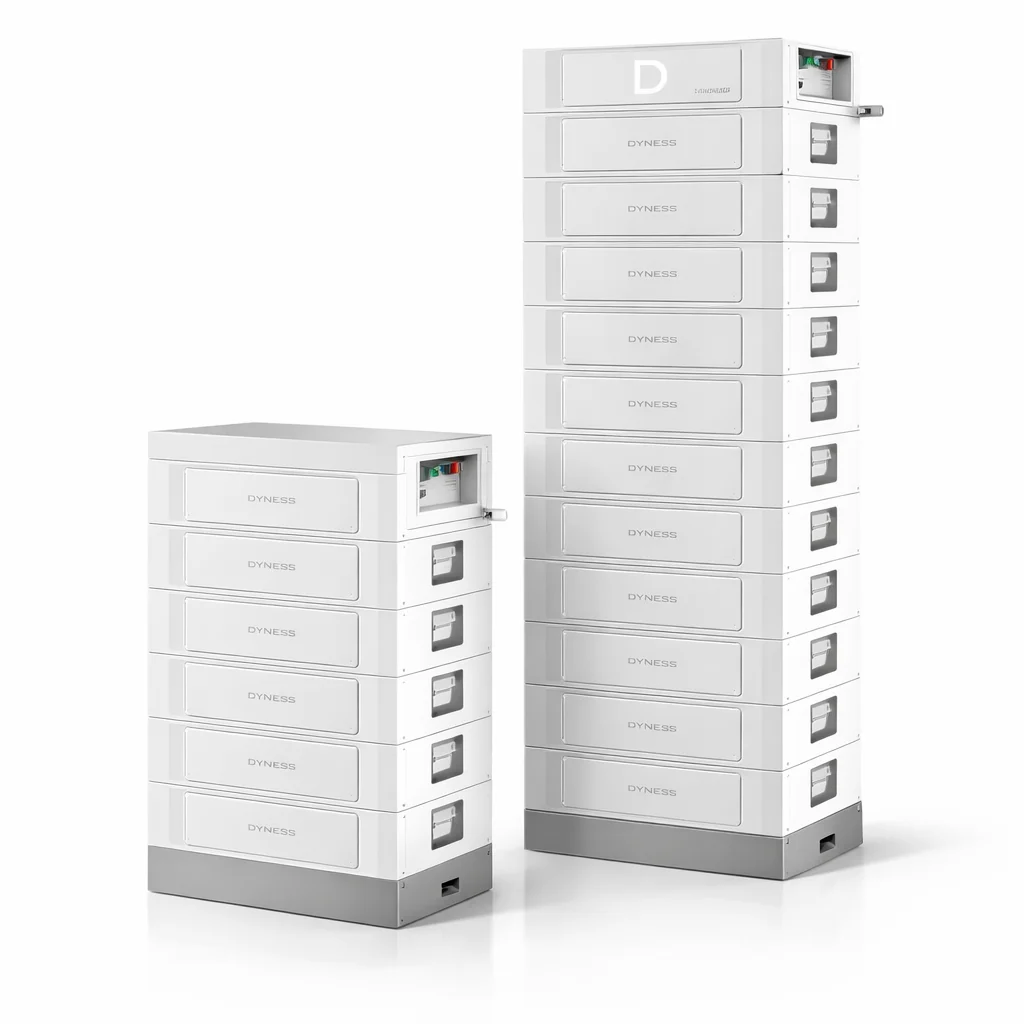

Dyness STACK100 5.12kWh HV Lithium Battery
Starting from ₨ 965,000Multiple stack configurations available
Component Prices
| Component | Unit | Current Price | Availability |
|---|---|---|---|
| Dyness STACK100 BDU | 1 Unit | ₨ 200,000 | In stock |
| Dyness STACK100 Battery Module - 5.12 kWh | Per Module | ₨ 255,000 | In stock |
Available Stack Configurations
| System Capacity | Battery Modules | BDU | Current Price |
|---|---|---|---|
| 15.36 kWh | 3 | 1 | ₨ 965,000 |
| 20.48 kWh | 4 | 1 | ₨ 1,220,000 |
| 25.6 kWh | 5 | 1 | ₨ 1,475,000 |
| 30.72 kWh | 6 | 1 | ₨ 1,730,000 |
| 35.84 kWh | 7 | 1 | ₨ 1,985,000 |
| 40.96 kWh | 8 | 1 | ₨ 2,240,000 |
| 46.08 kWh | 9 | 1 | ₨ 2,495,000 |
| 51.2 kWh | 10 | 1 | ₨ 2,750,000 |
| 56.32 kWh | 11 | 1 | ₨ 3,005,000 |
| 61.44 kWh | 12 | 1 | ₨ 3,260,000 |
| 66.56 kWh | 13 | 1 | ₨ 3,515,000 |
| 71.68 kWh | 14 | 1 | ₨ 3,770,000 |
| 76.8 kWh | 15 | 1 | ₨ 4,025,000 |
Prices are subject to stock availability and confirmation. Installation, delivery and compatible inverter requirements may be quoted separately.
Last price update: 2026-09-29 12:30:43
The Dyness STACK100 is a modular LiFePO₄ lithium battery designed for residential and small commercial energy storage. Each battery module provides 5.12kWh nominal energy, with a 51.2V nominal voltage and 100Ah capacity. The stackable design supports flexible expansion from 3 to 15 modules, giving system capacities from 15.36kWh to 76.8kWh. The system supports high-voltage operation, CAN/RS485 communication, 1C charge/discharge performance and built-in fire protection, making it suitable for solar backup and energy storage applications.
Quick Highlights
- Battery Chemistry: LiFePO₄
- Module Energy: 5.12kWh
- Nominal Voltage: 51.2V
- Module Capacity: 100Ah
- Maximum Charge/Discharge Current: 100A (1C)
- System Energy Range: 15.36–76.8kWh
- Warranty: 10 years long warranty
Dyness STACK100 HV Lithium Battery Overview
The Dyness stack 100 hv lithium battery is a modular energy storage solution built around LiFePO₄ battery chemistry. Each module provides 5.12kWh nominal energy, a 51.2V nominal voltage and 100Ah capacity. This design suits residential solar battery storage and small commercial energy-storage applications. The Dyness STACK100 5.12kWh lithium battery price in Pakistan is an important factor when planning a solar energy storage system, and the right configuration depends on your backup requirements and inverter compatibility.
Installers can combine 3 to 15 battery modules in one stack. As a result, the nominal storage capacity ranges from 15.36kWh to 76.8kWh, depending on the number of modules selected.
In addition, the system supports up to 12 clusters in parallel, allowing larger energy-storage configurations with a stated total capacity of up to approximately 921kWh.
The battery system operates within a 134–864V voltage range when configured as a high-voltage energy-storage system. However, each individual module has a nominal voltage of 51.2V. Multiple modules form the higher-voltage stack, so installers must check system configuration and inverter compatibility before installation.
Key Features and Buyer Benefits
LiFePO₄ Battery Chemistry
The Dyness STACK100 uses LiFePO₄ cells, a lithium battery chemistry commonly used in stationary energy storage. This battery supports repeated charging and discharging in suitable solar and energy-storage systems.
For buyers planning solar battery storage, the chemistry provides a solution designed for regular energy cycling. Actual performance depends on operating conditions, system settings and correct installation.
Modular Stackable Design
The modular design lets installers combine 3 to 15 modules in one stack. This flexibility helps them select storage capacity according to the property’s energy requirements.
Each module provides 5.12kWh of nominal energy. Therefore, a stack containing 15 modules reaches 76.8kWh of nominal energy. Buyers can choose a suitable configuration based on the required storage capacity and compatible system design.
1C Charge and Discharge Capability
The battery supports a maximum charge/discharge current of 100A at 1C. It also provides a peak discharge current of 125A for 2 minutes at 25°C.
These ratings help installers assess the battery’s charging and discharging capability when designing an energy-storage system. However, the inverter and battery configuration must remain within the specified electrical limits.
High Cycle Life
The STACK100 has a rated cycle life of more than 8,000 cycles under the stated test conditions. The actual service life can vary with operating temperature, depth of discharge, charging and discharging patterns, battery-management settings and system configuration.
For this reason, buyers should treat the cycle-life figure as a performance rating under defined conditions rather than a guarantee of identical service life in every installation.
Built-In Fire Protection
The battery includes a built-in aerosol fire-extinguishing system with a stated response time of approximately 5 seconds. This feature adds a layer of fire protection to the energy-storage installation.
Correct installation, suitable electrical protection and compliance with the applicable safety requirements remain essential.
CAN/RS485 Communication
The battery supports CAN and RS485 communication for integration with compatible energy-storage equipment. These interfaces help the battery communicate with supported system components and enable coordinated battery management.
Before installation, confirm that the selected inverter supports the required communication protocol and configuration.
Flexible System Expansion
The modular architecture supports storage configurations from 15.36kWh to 76.8kWh per stack, depending on the number of modules installed. In addition, the system can support up to 12 clusters in parallel for larger storage requirements.
The final configuration must follow the system’s electrical limits and compatibility requirements.
For additional information click Dyness Official Website.
Best For
The Dyness STACK100 HV lithium battery is suitable for:
- Residential solar battery storage
- Homes requiring higher backup energy capacity
- Small commercial energy-storage systems
- Solar installations that need modular battery expansion
- High-voltage battery-storage installations
- Users considering a move from conventional lead-acid storage to lithium technology
- Projects where storage capacity may need to increase over time
Not Ideal For
The STACK100 may not suit an installation without further system checks if:
- The inverter does not support the required battery voltage architecture.
- The inverter’s CAN/RS485 communication requirements are incompatible.
- The required load exceeds the battery’s charging or discharging limits.
- The installation environment falls outside the specified temperature range.
- The project specifically requires a compact, single-module low-voltage battery.
Before purchasing, check the battery and inverter compatibility, electrical limits, communication requirements and installation conditions.
Battery Capacity: kWh, Ah and Usable Energy Explained
Battery capacity is commonly expressed in ampere-hours (Ah) and kilowatt-hours (kWh). These units describe different aspects of battery capacity.
Each STACK100 module has a 51.2V nominal voltage and 100Ah capacity. The nominal energy calculation is:
51.2V × 100Ah ÷ 1,000 = 5.12kWh
Therefore, each module provides 5.12kWh of nominal energy.
A configuration with 3 modules provides 15.36kWh, while a 15-module stack provides 76.8kWh of nominal energy. The battery also has a 95% depth of discharge (DoD) rating. However, actual usable energy depends on system settings, operating conditions and battery-management limits.
Battery Chemistry and Cycle Life
The LiFePO₄ chemistry supports repeated energy storage and release in suitable applications. The STACK100 has a rated cycle life of more than 8,000 cycles under the stated test conditions.
Several factors influence cycle performance:
- Depth of discharge
- Charging and discharging conditions
- Operating temperature
- Battery-management settings
- Installation and system configuration
Consequently, the rated cycle life should not be treated as a guarantee of a specific real-world operating life. Correct system design and operation within the specified limits remain important.
Battery Management System and Safety
The STACK100 includes battery-management and safety features designed to support controlled energy storage. A built-in aerosol fire extinguisher provides an additional fire-protection feature, while CAN/RS485 communication supports interaction with compatible energy-storage equipment.
For safe operation, keep charging and discharging within the battery’s specified electrical limits. Installers should also assess the installation environment, ventilation, electrical protection and inverter compatibility before commissioning the system.
Charging and Discharging Performance
The STACK100 supports the following charging and discharging ratings:
- Recommended charge/discharge current: 50A (0.5C)
- Maximum charge/discharge current: 100A (1C)
- Peak discharge current: 125A for 2 minutes at 25°C
- Depth of discharge: 95%
These values help installers match the battery to the inverter and expected loads. However, the complete system must follow the battery’s electrical limits and the inverter’s supported operating parameters.
Inverter Compatibility
The Dyness stack 100 hv lithium battery is designed for integration with compatible energy-storage inverter systems through CAN/RS485 communication.
Before selecting an inverter, check the following requirements:
- Battery voltage range
- Inverter battery architecture
- Maximum charge current
- Maximum discharge current
- Battery Management System (BMS) communication protocol
- Communication wiring and configuration
Hajvery Solar Energy can help buyers review battery and inverter matching requirements before purchase. As a Dyness authorized dealer, Hajvery Solar Energy can also assist with product selection and system-compatibility guidance.
Parallel Expansion
The STACK100 supports modular expansion through stacks containing 3 to 15 battery modules. The nominal energy capacity varies with the number of modules installed.
| Number of Modules | Nominal Energy Capacity |
|---|---|
| 3 | 15.36kWh |
| 4 | 20.48kWh |
| 5 | 25.6kWh |
| 6 | 30.72kWh |
| 7 | 35.84kWh |
| 8 | 40.96kWh |
| 9 | 46.08kWh |
| 10 | 51.2kWh |
| 11 | 56.32kWh |
| 12 | 61.44kWh |
| 13 | 66.56kWh |
| 14 | 71.68kWh |
| 15 | 76.8kWh |
In addition, the system supports up to 12 clusters in parallel for larger energy-storage arrangements. The final number of modules and clusters must be selected according to the required capacity, supported configuration and applicable electrical limits.
Technical Specifications
| Specification | Details |
|---|---|
| Brand | Dyness |
| Model | STACK100 |
| Battery Chemistry | LiFePO₄ |
| Nominal Voltage per Module | 51.2V |
| Module Capacity | 100Ah |
| Nominal Energy per Module | 5.12kWh |
| System Energy Range per Stack | 15.36–76.8kWh |
| System Operating Voltage | 134–864V |
| Recommended Charge/Discharge Current | 50A (0.5C) |
| Maximum Charge/Discharge Current | 100A (1C) |
| Peak Discharge Current | 125A for 2 minutes at 25°C |
| Depth of Discharge | 95% |
| Communication | CAN/RS485 |
| Cycle Life | More than 8,000 cycles under stated test conditions |
| Charging Temperature | 0–55°C |
| Discharging Temperature | -20–55°C |
| Protection Rating | IP20 |
| Fire Protection | Built-in aerosol fire extinguisher |
| Installation Method | Stack type |
| Cooling Method | Forced-air cooling |
| Wi-Fi | Built-in Wi-Fi module with app OTA function |
| Single Module Weight | 47kg |
Lithium Battery Use in Pakistan
A modular lithium battery can support Pakistani solar installations that require load-shedding backup, stored solar energy and energy management. The STACK100’s expandable design allows buyers to select a storage configuration according to their energy requirements.
For example, a smaller installation can use fewer modules, while a larger project may require additional modules or supported parallel clusters. The correct configuration depends on the expected load, backup duration, inverter compatibility and required storage capacity.
Before installation in Pakistan, consider:
- Battery and inverter compatibility
- Suitable indoor installation environment
- Operating temperature
- Ventilation requirements
- Correct battery communication
- Charge/discharge limits
- Appropriate electrical protection
The battery has an IP20 protection rating. Therefore, the installation location should provide an appropriate environment and protection against conditions that the rating does not cover.
Dyness STACK100 Price in Pakistan
The Dyness stack 100 hv lithium battery price in Pakistan depends on whether you need an individual battery module or a complete multi-module stack.
The current price of the Dyness STACK100 5.12kWh battery module in Pakistan is Rs. 255,000 per module.
The total cost of a complete system depends on the number of modules required. Contact Hajvery Solar Energy to check current availability and pricing for the required quantity and configuration.
Hajvery Solar Energy is a Dyness Official Distributor and can assist buyers with product selection, compatibility checks and availability enquiries.
Hajvery Compatibility and Authenticity Check
Before buying a Dyness STACK100 HV lithium battery, confirm the exact model, required number of modules and intended inverter configuration.
Hajvery Solar Energy can assist with:
- Exact-model identification
- Battery and inverter compatibility checks
- Required battery capacity assessment
- Communication compatibility checks
- Warranty-related guidance
- Availability confirmation
As a Dyness authorized dealer, Hajvery Solar Energy can help buyers assess product-selection and system-compatibility requirements before purchase.
Warranty and After-Sales Support
The Dyness STACK100 comes with a 10-year warranty.
Buyers should check the applicable warranty terms and conditions for their product and installation. Warranty coverage and eligibility depend on the terms that apply to the purchase.
Hajvery Solar Energy is an Official Dyness Distributor and can help customers with product guidance, compatibility checks and warranty-related support. Buying through an authorized Dyness dealer such as Hajvery Solar Energy provides customers with a route for product and warranty enquiries.
Before You Buy
Before purchasing the Dyness STACK100, review the following points:
- Required total kWh storage capacity
- Number of battery modules needed
- Inverter battery-voltage compatibility
- CAN/RS485 communication compatibility
- Maximum charging current
- Maximum discharge current
- Expected backup load
- Installation location and temperature
- Future expansion requirements
- Applicable warranty terms
These checks help buyers and installers select a suitable configuration and reduce the risk of compatibility problems.
FAQs
What is the Dyness STACK100 HV Lithium Battery?
The Dyness STACK100 is a modular LiFePO₄ lithium battery. Each module provides 5.12kWh nominal energy, 51.2V nominal voltage and 100Ah capacity.
What is the current price of the Dyness STACK100 in Pakistan?
The current price of the Dyness STACK100 5.12kWh battery module in Pakistan is Rs. 255,000 per module.
How much does a complete Dyness STACK100 battery system cost?
The total price depends on the number of modules in the required configuration. A stack can contain 3 to 15 modules, providing 15.36kWh to 76.8kWh of nominal energy. Contact Hajvery Solar Energy for pricing based on the required configuration.
Can the Dyness STACK100 be used for solar backup?
Yes. The STACK100 is intended for residential and small commercial energy-storage applications. It can be integrated with a compatible solar energy system when the inverter, battery voltage and communication requirements match.
What should I consider in a Dyness STACK100 HV lithium battery review?
For a practical Dyness stack 100 hv lithium battery review, assess the 5.12kWh module capacity, LiFePO₄ chemistry, charging and discharging limits, rated cycle life, modular expansion and inverter compatibility. Installation conditions and the required backup capacity also matter.
Can the Dyness STACK100 operate in a high-voltage system?
Yes. Multiple modules form a high-voltage energy-storage system with an operating voltage range of 134–864V. The final configuration must match the supported system design and compatible inverter.
What should I check before buying a charger for the Dyness STACK100?
Match the charging equipment to the complete battery system and compatible inverter architecture. Before purchase, check the required voltage, current limits and communication configuration.
Can the Dyness STACK100 battery system be expanded?
Yes. The system supports 3–15 modules per stack and up to 12 clusters in parallel, subject to the supported configuration and electrical limits.
Buy Dyness STACK100 from Hajvery Solar Energy
The Dyness STACK100 is a modular 5.12kWh LiFePO₄ lithium battery module designed for expandable solar energy storage. Its 51.2V nominal voltage, 100Ah capacity, CAN/RS485 communication, 1C maximum charge/discharge capability and built-in fire protection support properly designed residential and small commercial storage systems.
Contact Hajvery Solar Energy for the current Dyness lithium battery price in Pakistan, availability, inverter compatibility checks and system-sizing guidance.
To explore more options click the link given below:
Dyness Lithium Batteries In Pakistan.
Related products


 Crown
 FUJI
 INVENT
 INVT (CHF)
 VEICHI
 EVE
 INVEREX
Reviews
There are no reviews yet.